
Week in Review: Iran Conflict Stokes Inflation Fears

Apr
In this Edition:
STRONG HEADLINE JOBS DATA MASKS WEAKENING LABOUR MARKET TRENDS AS RATE-CUT EXPECTATIONS FADE
US labour data beat expectations, but underlying softness and geopolitical uncertainty have reduced the likelihood of near-term Fed rate cuts.
ENERGY-DRIVEN INFLATION SURGE KEEPS ECB CAUTIOUS DESPITE IMPROVING GROWTH OUTLOOK
Rising energy costs pushed Eurozone inflation above target, prompting the ECB to maintain a vigilant stance on potential rate hikes.
POLICY UNCERTAINTY IN JAPAN AND MIXED CHINESE DATA KEEP REGIONAL MARKETS UNEVEN
Asian markets showed mixed performance amid Japan’s potential rate hikes and ongoing weakness in China’s domestic demand.
STRONG TAX REVENUES AND MARKET REBOUND OFFSET PRESSURE FROM RISING FUEL COSTS
South Africa benefited from stronger-than-expected tax collections and equity gains, although elevated fuel prices continue to pose inflation risks.
MARKET MOVES OF THE WEEK
Source: Infront (05 April 2026)
CHART OF THE WEEK
Source: U.S. Bureau of Labor Statistics (03 April 2026)
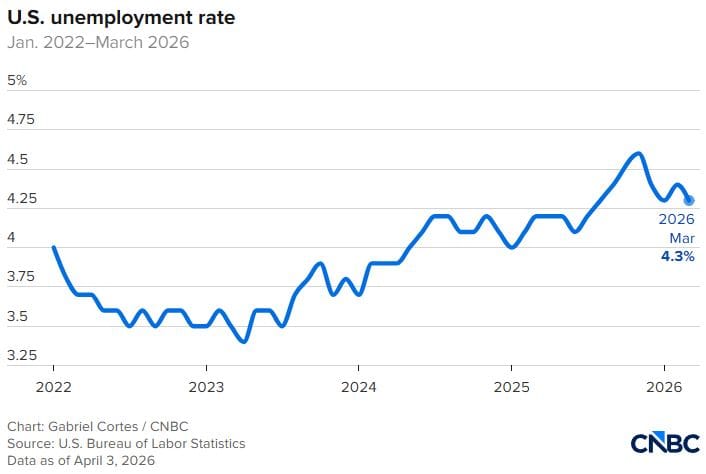
US nonfarm payrolls rebounded to 178,000 in March, reversing February’s 133,000 decline and comfortably beating the 59,000-consensus estimate. The three-month average, however, sits at a more modest 68,000, consistent with a slow-growth labour market. The unemployment rate edged down to 4.3%, though the improvement was flattered by a 396,000 contraction in the labour force, pushing the participation rate to 61.9%, its lowest since November 2021.
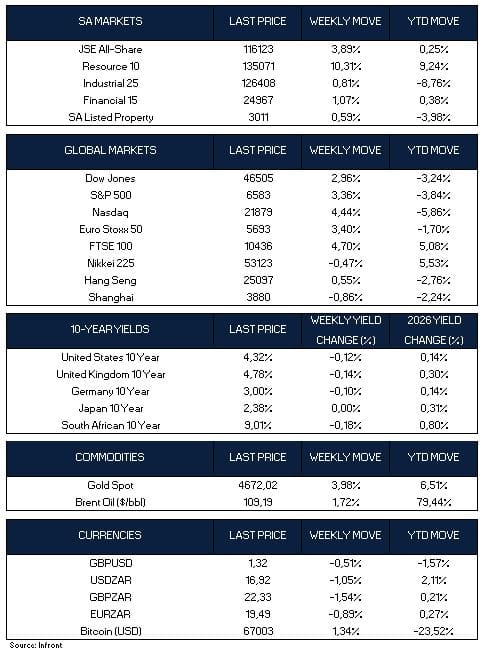
Global equity markets ended a volatile, holiday-shortened week in positive territory, with tentative signs of Middle East de-escalation lifting sentiment. The Nasdaq led the way, logging its best week since November, while the S&P 500 and Dow gained 3.36% and 2.96%, respectively. European markets followed suit, with the STOXX 50 up 3.4% and the UK’s FTSE 100 gaining 4.7%.
Strong headline jobs data masks weakening labour market trends as rate-cut expectations fade
The mood swung sharply through the last week. Equities rallied early on hopes the US campaign in Iran was nearing its end, only to reverse after Trump’s Wednesday evening address threatened further escalation, including strikes on Iranian oil facilities over the next two to three weeks, while offering no plan to reopen the Strait of Hormuz. Markets largely recovered by Thursday’s close.
Brent crude surged above $109/barrel, its highest level in nearly four years, on renewed supply disruption fears, while gold rebounded nearly 4% to around $4,672/oz as the dollar strengthened and rate cut hopes faded. US Treasuries advanced, with the 10-year yield falling from 4.44% to 4.31%, aided by Fed Chair Powell’s comments tempering near-term inflation concerns.
On the labour market, the US added 178,000 jobs in March, well ahead of the 59,000 consensus estimate, and the unemployment rate dipped to 4.3%. However, the headline figures masked softer underlying trends: job openings fell to 6.9 million in February from 7.2 million in January, hiring slid to its lowest since 2020, and the labour force shrank by 396,000, with the participation rate dropping to 61.9%, its lowest since November 2021. Economists cautioned that the Iran war is making businesses more hesitant to hire, with the full impact likely more visible in the April report. Markets now price virtually no Fed rate move through year-end, with futures pointing to a 77.5% probability of rates on hold.
Energy-driven inflation surge keeps ECB cautious despite improving growth outlook
Eurozone inflation jumped to 2.5% in March from 1.9% in February, above the ECB’s 2% target, driven by a 4.9% surge in energy costs. ECB President Lagarde signalled the central bank is monitoring the situation closely and stands ready to hike rates if necessary, even if the inflation spike proves temporary.
Policy uncertainty in Japan and mixed Chinese data keep regional markets uneven
Japan’s Nikkei fell 0.5% amid expectations the Bank of Japan may raise rates at its April meeting in response to oil-driven inflation pressures. Chinese markets were mixed, while Beijing and Islamabad jointly proposed a five-point peace plan calling for a ceasefire and protection of the Strait of Hormuz shipping lanes.
This week, focus remains on the Iran conflict as it enters its sixth week, alongside US CPI, FOMC minutes, the PCE report, Michigan Consumer Sentiment, and monetary policy decisions from the Reserve Bank of India.
Strong tax revenues and market rebound offset pressure from rising fuel costs
South African Revenue Service (SARS) collected a net R2.01 trillion in tax for the fiscal year ended 31 March, 8.4% higher year-on-year and R24.7 billion above the 2025 budget forecast. The agency credited compliance initiatives, improved efficiency, and a strong contribution from the mining sector. For 2026/27, SARS is targeting R2.13 trillion, a 5.8% increase.
President Ramaphosa has appointed Ngobani Makhubu as the new SARS Commissioner for five years, effective 1 May. Makhubu, currently Deputy Commissioner for Taxpayer Engagement and Operations, takes over from Edward Kieswetter, who steps down after seven years at the helm.
On the fuel front, petrol rose R3.06/litre to R23.25 from 1 April, while inland diesel hit a record R26.11/litre, up R7.51. The Iran conflict, which has pushed Brent above $100/barrel and pressured the rand, is the primary driver. A R3/litre fuel levy cut softened the blow; without it, economists warned the increase could have added at least 1.0 percentage point to annual CPI in April. February CPI came in at 3.0% year-on-year, bang on the SARB’s target, leaving little room for an unmanaged fuel shock.
Markets recovered some recent losses, with the FTSE/JSE All Share ending the holiday-shortened week 3.9% higher, buoyed by resource counters. The rand also firmed, gaining over 1% to close at R16.92/$.
The information contained in this recording/presentation is for general information purposes only and should not be construed as, nor does it constitute financial, tax, legal, investment or any other advice. Carrick does not guarantee the suitability or potential value of any products or investments discussed herein. We make no representations or warranties of any kind, express or implied, about the completeness, accuracy, reliability, suitability or availability with respect to the information, products, services, or any other content contained in this recording for any purpose. Carrick accepts no responsibility for the suitability or accuracy of the information or for any errors or omissions that may occur. Therefore, any reliance you place on such information is strictly at your own risk. This material is provided for general information purposes only and is not personal advice to anyone to invest in any fund or product. Information taken from trade and other sources is believed to be reliable, although Carrick does not represent this as accurate or complete and it shouldn’t be relied upon as such. All material, content, and information provided by Carrick is the intellectual property of Carrick Group and its affiliates, unless otherwise stated. No part of this material may be copied, reproduced, distributed, published, or used for any commercial purpose without Carrick’s prior written consent, and is provided solely for non-commercial use. Capital is at risk. The value and income from investments can go down as well as up and are not guaranteed. An investor may get back significantly less than they invest. Past performance is not a reliable indicator of current or future performance and should not be the sole factor considered when selecting an investment.