
Week in Review: US Inflation Holds Steady

Sep
In this Edition:
Inflation and Growth Data Weigh on Equities
U.S. equities fell for the week as PCE inflation held steady, GDP growth was revised higher, and Fed commentary highlighted ongoing policy uncertainty.
Mixed Economic Signals Amid Modest Growth
Equities Rise Despite Diverging Regional Trends
Japanese equities gained on steady inflation, while Chinese markets were mixed with modest gains in Shanghai offset by losses in Hong Kong.
Safe-Haven Demand and Key Economic Releases Ahead
Gold remained near record highs and oil surged amid supply concerns, as markets prepare for upcoming U.S. employment data, European inflation releases, and central bank rate decisions.
Rising Inflation Amid Weakening Confidence
South Africa saw producer inflation accelerate and consumer confidence decline, while the JSE gained modestly on strong resource stocks and the rand strengthened slightly.
Market Moves and Chart of the Week
Inflation and Growth Data Weigh on Equities
U.S. equities ended Friday higher but still closed last week in negative territory as investors digested key inflation data. The Federal Reserve’s preferred gauge, the personal consumption expenditures (PCE) price index, rose 0.3% in August, lifting the annual headline rate to 2.7% from 2.6% in July. Core PCE, which excludes food and energy, increased 0.2% for the month and held steady at 2.9% annually, in line with consensus forecasts.
The Bureau of Economic Analysis also revised second-quarter GDP growth to an annualized 3.8%, up from the prior 3.3% estimate, with consumer spending providing the largest boost.
Fed Chair Jerome Powell reiterated last week that while inflation expectations remain anchored near the Fed’s 2% target, downside risks to employment and elevated uncertainty leave policymakers without a “risk-free” policy path. He also noted that tariffs are likely to result in a one-time price adjustment spread over several quarters.
Major U.S. indices ended last week lower, with the Nasdaq Composite and S&P 500 sliding 0.65% and 0.31% respectively, marking each index’s first losing week in four, while the Dow shed 0.15%.
Mixed Economic Signals Amid Modest Growth
In Europe, the STOXX Europe 50 Index rose 0.76%, as markets weighed rate policy developments and ongoing trade tensions. Economic surveys signalled modest growth in the third quarter, with services activity expanding at the fastest pace this year, while manufacturing output lagged. Business confidence dipped to a four-month low.
In the UK, the PMI fell to 51.0, down from 53.5 in August, as both services and manufacturing slowed. Confidence also dropped to its weakest level since June, ahead of the November budget, nevertheless the FTSE 100 gained 0.74% for last week.
Equities Rise Despite Diverging Regional Trends
Japanese equities advanced, with the Nikkei 225 Index up 0.69%. Inflation in the Tokyo area rose 2.5% year-on-year in September, unchanged from August but slightly below expectations. In China, the Shanghai Composite Index gained 0.21%, while Hong Kong’s Hang Seng Index declined 1.54%.
Safe-Haven Demand and Key Economic Releases Ahead
Gold held above $3,750 per ounce, near record highs, supported by safe-haven demand despite a stronger dollar and higher Treasury yields, while oil prices advanced, set for their steepest rise since June, as Ukraine’s strikes on Russian energy infrastructure prompted supply concerns.
The week ahead brings a full slate of economic releases, led by the closely watched U.S. employment report, which will provide fresh insight into payroll growth, unemployment trends, and wage pressures—key indicators shaping the Federal Reserve’s policy outlook. In Europe, attention will centre on new inflation data for the eurozone and its member states, alongside CPI figures from Turkey and Switzerland. On the monetary policy front, interest rate decisions in Australia and India will also be in focus.
Rising Inflation Amid Weakening Confidence
In local news, South Africa’s producer inflation accelerated to 2.1% year-on-year in August, up from 1.5% in July, according to Statistics South Africa. On a monthly basis, the Producer Price Index (PPI) rose 0.3%, with the increase driven largely by higher prices in the food, beverages, and tobacco category, which climbed from 3.9% to 4.3% year-on-year as food inflation reached 4.1%.
Meanwhile, confidence indicators painted a weaker picture. The FNB/BER Consumer Confidence Index dropped sharply in the third quarter, retreating to -13, as households reported worsening financial positions and a weaker economic outlook. Retailer confidence also declined significantly, hitting its lowest level in a year.
In markets, the JSE All Share Index ended last week 0.56% higher, supported by continued strength in resource stocks. The rand firmed in late Friday trade, closing at R17.32 per U.S. dollar.
Market Moves of the Week
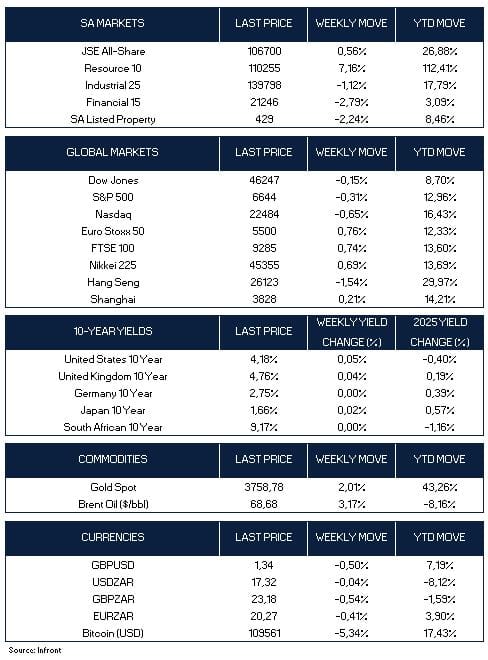
Chart of the Week
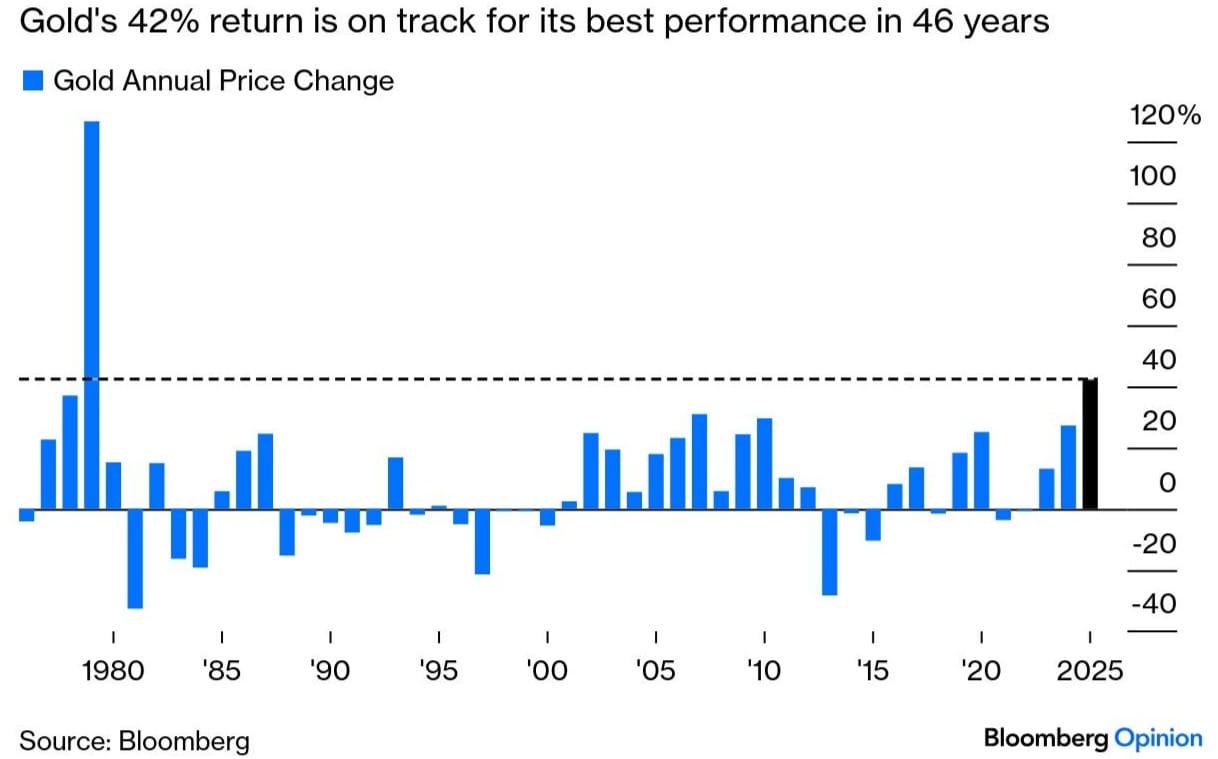
Gold has extended its rally this year, rising more than 40% and on track for its strongest annual performance in over four decades. Not since 1979—when the metal more than doubled amid investor fears that inflation would never abate—has gold experienced such a powerful and sustained surge.
The information contained in this recording/presentation is for general information purposes only and should not be construed as, nor does it constitute financial, tax, legal, investment or any other advice. Carrick does not guarantee the suitability or potential value of any products or investments discussed herein. We make no representations or warranties of any kind, express or implied, about the completeness, accuracy, reliability, suitability or availability with respect to the information, products, services, or any other content contained in this recording for any purpose. Carrick accepts no responsibility for the suitability or accuracy of the information or for any errors or omissions that may occur. Therefore, any reliance you place on such information is strictly at your own risk. This material is provided for general information purposes only and is not personal advice to anyone to invest in any fund or product. Information taken from trade and other sources is believed to be reliable, although Carrick does not represent this as accurate or complete and it shouldn’t be relied upon as such. All material, content, and information provided by Carrick is the intellectual property of Carrick Group and its affiliates, unless otherwise stated. No part of this material may be copied, reproduced, distributed, published, or used for any commercial purpose without Carrick’s prior written consent, and is provided solely for non-commercial use. Capital is at risk. The value and income from investments can go down as well as up and are not guaranteed. An investor may get back significantly less than they invest. Past performance is not a reliable indicator of current or future performance and should not be the sole factor considered when selecting an investment.