


In this Edition:
US growth slows as inflation firms and trade tensions re-emerge
GDP slowed, inflation edged higher, Fed policy uncertainty persisted, trade tensions resurfaced, and equities ended modestly stronger.
European markets gain as UK inflation eases and eurozone output contracts
UK inflation cooled, eurozone production declined, rate-cut expectations firmed, and equities advanced.
Asia subdued as IMF trims China outlook and markets pause for holidays
China’s growth outlook softened, trading was muted by holidays, and regional markets were mixed.
South Africa sees inflation relief and labour gains despite rand softness
Inflation eased, unemployment improved modestly, equities gained, and the rand weakened slightly.
MARKET MOVES OF THE WEEK
Source: Infront (22 February 2026)
CHART OF THE WEEK
Source: FactSet (22 February 2026)
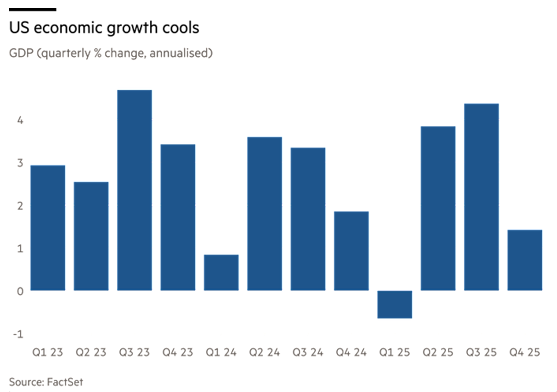
U.S. GDP rose at an annualised 1.4% in the fourth quarter of 2025, well below expectations. The Commerce Department estimated that the government shutdown reduced growth by roughly one percentage point, contributing to the slowdown from earlier in the year. For 2025 overall, growth moderated to 2.2%, down from 2.8% in 2024.
US growth slows as inflation firms and trade tensions re-emerge
Data released by the Bureau of Economic Analysis (BEA) showed that U.S. growth slowed more than expected in the fourth quarter of 2025, with GDP expanding at an annualised 1.4%. The deceleration was largely driven by a sharp contraction in government spending amid the shutdown, which weighed on overall activity. Consumer spending remained comparatively resilient at 2.4%, though momentum softened relative to earlier in the year, while government spending declined 16.6%. For 2025 overall, economic growth moderated to 2.2% from 2.8% in 2024.
Separately, the BEA reported that headline PCE inflation rose 2.9% year-on-year in December, edging higher from the prior month and marking its highest level since March 2024. Core PCE, the Federal Reserve’s preferred gauge of underlying inflation, which excludes food and energy, increased 0.4% month-on-month and 3.0% year-on-year, accelerating from November’s 0.2% and 2.8%, respectively.
Minutes from the Federal Reserve’s January meeting, released on Wednesday, highlighted a clear split among policymakers over the next move in rates. While some members indicated that additional easing could be appropriate if inflation continues to cool, others pointed to “the possibility that upward adjustments” may be required should price pressures remain elevated. The minutes also noted that the “vast majority of participants” believe downside risks to employment have eased, though the risk of more entrenched inflation remains a concern.
In a 6–3 decision, the U.S. Supreme Court ruled that President Trump exceeded his authority in using the International Emergency Economic Powers Act (IEEPA) to impose tariffs on nearly all U.S. trading partners last year. President Trump responded critically to the decision and subsequently announced the implementation of a 10% global tariff, signalling continued intent to pursue an assertive trade stance despite the Court’s ruling.
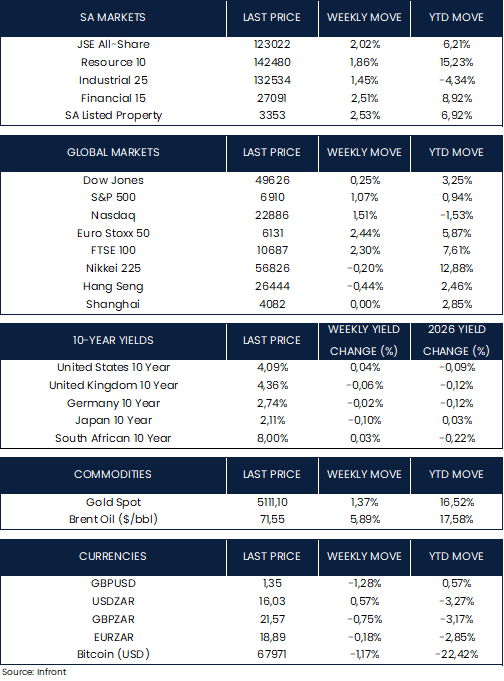
U.S. equity markets closed the holiday-shortened week higher. The Nasdaq Composite led gains, advancing 1.51% and recording its first weekly increase since early January. The S&P 500 rose 1.07%, while the Dow Jones Industrial Average lagged the broader market, ending last week up 0.25%.
European markets gain as UK inflation eases and eurozone output contracts
UK CPI eased to 3.0% year on year in January, its lowest level in almost a year, partly due to lower fuel prices. Labour market data were also softer, with unemployment rising to 5.2% in the three months to December and wage growth slowing. The data have supported expectations that the Bank of England may cut interest rates at its March meeting, although inflation remains above the 2.0% target.
Seasonally adjusted industrial production in the eurozone declined 1.4% month on month in December, according to Eurostat, a sharper contraction than expected. In contrast, the preliminary February PMI surprised to the upside, with new orders expanding at their fastest pace in nearly four years.
European equities delivered solid gains over the last week, with the STOXX Europe 50 rising 2.44% in local currency terms. The FTSE 100 also advanced 2.30%, touching a fresh intraweek high.
Asia subdued as IMF trims China outlook and markets pause for holidays
The International Monetary Fund expects China’s economy to grow 4.5% in 2026, slightly above its October forecast but below the 5% recorded in 2025. Following its Article IV consultation, the IMF noted that while growth has been resilient, structural challenges are intensifying and emphasised the need for a stronger shift toward consumption-led growth, supported by both macroeconomic measures and deeper reforms.
In Asia, performance was more subdued. Japan’s Nikkei 225 edged 0.20% lower. Mainland Chinese markets were closed for the Lunar New Year from February 16 and will reopen on February 24. Hong Kong trading was suspended from February 17 to 19, following a half-day session on February 16, before resuming on Friday. The Hang Seng Index ended last week down 0.44%.
South Africa sees inflation relief and labour gains despite rand softness
Headline consumer price inflation in South Africa eased to 3.5% year on year in January 2026, down from 3.6% in December 2025, according to Statistics South Africa. The main contributors to the January reading were housing and utilities, food and non-alcoholic beverages, and insurance and financial services. Core inflation, which excludes food, non-alcoholic beverages, fuel and energy, increased to 3.4%, its highest in nearly a year.
Separately, Stats SA’s Quarterly Labour Force Survey reported that the official unemployment rate declined to 31.4% in the fourth quarter of 2025, from 31.9% in the third quarter, reflecting a modest improvement in labour market conditions. Overall, South Africa’s labour market shows improvements across multiple measures. However, unemployment levels remain exceptionally high, underscoring the persistence of the country’s structural jobs crisis.
The JSE All Share Index also ended last week in positive territory, gaining 2.02%, with broad-based strength across all sectors. In contrast, the rand softened slightly, depreciating 0.57% against the U.S. dollar to close at R16.03 on Friday.
The information contained in this recording/presentation is for general information purposes only and should not be construed as, nor does it constitute financial, tax, legal, investment or any other advice. Carrick does not guarantee the suitability or potential value of any products or investments discussed herein. We make no representations or warranties of any kind, express or implied, about the completeness, accuracy, reliability, suitability or availability with respect to the information, products, services, or any other content contained in this recording for any purpose. Carrick accepts no responsibility for the suitability or accuracy of the information or for any errors or omissions that may occur. Therefore, any reliance you place on such information is strictly at your own risk. This material is provided for general information purposes only and is not personal advice to anyone to invest in any fund or product. Information taken from trade and other sources is believed to be reliable, although Carrick does not represent this as accurate or complete and it shouldn’t be relied upon as such. All material, content, and information provided by Carrick is the intellectual property of Carrick Group and its affiliates, unless otherwise stated. No part of this material may be copied, reproduced, distributed, published, or used for any commercial purpose without Carrick’s prior written consent, and is provided solely for non-commercial use. Capital is at risk. The value and income from investments can go down as well as up and are not guaranteed. An investor may get back significantly less than they invest. Past performance is not a reliable indicator of current or future performance and should not be the sole factor considered when selecting an investment.