
Global Market Repricing Sharpens Mauritius Investors’ Focus on Currency and Rates

Nov
In this Edition:
The Federal Reserve’s minutes and the Bank of Mauritius’s recent rate increase put interest-rate sensitivity in focus, while a stronger US dollar makes the distinction between investment currency and Mauritian rupee spending needs more important.
GROWTH AND INFLATION IN EUROPE AND THE UK
Inflation in Europe and UK rate expectations add complexity to international portfolio decisions.
Weaker Asian data add further complexity to international portfolio decisions.
}South African inflation rose to 5.2%, the Reserve Bank kept the repo rate at 7.25%, and the JSE and rand fell while bond yields rose.
Market Moves and Chart of the Week
For Mauritius-based and internationally invested clients, the global retreat from AI-related shares arrives against a more demanding interest-rate environment at home and abroad. The Bank of Mauritius raised its Key Rate by 25 basis points to 5.00% on 11 November 2026, citing broadening inflation pressures (source below). As technology shares sell off and the US dollar strengthens, the relationship between portfolio currency, spending currency and long-term investment objectives becomes particularly relevant.
IN FOCUS | Global technology repricing
Technology shares led a sharp global sell-off this week, as strong results from NVIDIA and Anthropic’s record-breaking share listing failed to restore confidence in the AI trade. With investors still doubting whether the huge sums being spent on AI will pay off, the Nasdaq gave up all its gains for the year. Is this a healthy correction after a long rally, or the first sign that the AI bubble is bursting? Meanwhile, minutes from the Federal Reserve’s latest meeting signalled further interest rate hikes, lifting the US dollar to a 19-month high. In South Africa, uncertainty over coalition talks, along with the stronger dollar and a sharp fall in the gold price, pushed the rand to its weakest level in about a year.
IN FOCUS | US rates and the dollar
Support for higher interest rates at the Federal Reserve is broad, according to the minutes of its October meeting. Almost all officials expect more increases, with a couple open to a hike of more than 25 basis points in December if inflation data disappoints. Figures released this week showed that import prices rose 1.1% in October, more than expected. However, the University of Michigan’s survey found that consumers’ expectations for inflation over the next year fell to 3.7% from 4.7%.
Other economic data was mixed. Consumers kept spending, with retail sales rising 0.2% in October. By contrast, the Philadelphia Fed’s manufacturing index fell to 6.3 in November from 20.9, its lowest reading since May.
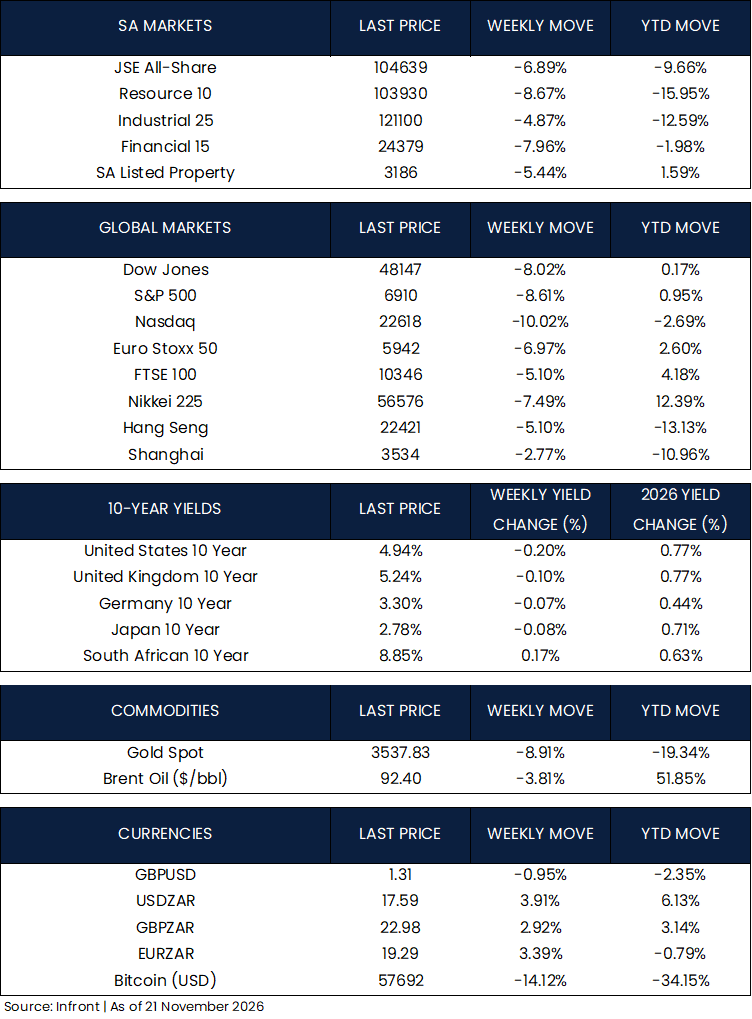
US equities had one of their worst weeks in years. The Dow fell 8.02%, its worst week since March 2020, while the S&P 500 lost 8.61% and the Nasdaq 10.02%. The S&P 500 and the Dow both fell into correction territory, more than 10% below their record highs. NVIDIA’s shares fell 22.9% over the week, even though the company reported a 103% rise in quarterly revenue. Anthropic’s shares opened at US$111.50 on Thursday, well above the US$83 listing price, but closed Friday at about US$88. Treasuries attracted safety buying as shares fell, and the 10-year yield slipped back below 5% to end the week at 4.94%.
IN FOCUS | Growth and inflation in Europe and the UK
The eurozone economy is holding up better than expected, but inflation remains high. The European Commission raised its 2026 growth forecast to 1.2% from 0.9%, as stronger exports helped the region cope with higher energy prices. However, it also raised its inflation forecast for this year to 3.2%. Eurostat confirmed that inflation reached 4.0% in October, its highest since September 2023. The better growth outlook did little to support European shares, which were caught up in the global sell-off. The Euro Stoxx 50 fell 6.97%.
UK inflation ticked up to 3.6% in October from 3.5%, but came in slightly below the Bank of England’s forecast. Higher fuel prices and an earlier increase in tobacco duty drove the rise. The softer-than-expected reading led investors to scale back bets on another Bank of England rate hike in December. Even so, UK shares could not escape the global sell-off, with the FTSE 100 down 5.10%.
IN FOCUS | Growth in Japan and China
Japan’s economy shrank at an annualised rate of 0.1% in the third quarter, its first contraction in a year, as higher prices weighed on consumer spending. Exports were a bright spot, rising 20.5% from a year earlier to a record ¥11.8 trillion in October on strong demand for chips. Core inflation rose to 2.2%, slightly below forecasts. Japanese shares fell sharply as the sell-off in US chipmakers reached Asia. The Nikkei 225 ended the week 7.49% lower.
China’s October activity data missed expectations, pointing to a soft start to the fourth quarter. Industrial output growth slowed to 4.8% from 5.5%, despite solid exports. Demand at home stayed weak, with retail sales up just 0.4% and fixed-asset investment down 8.1% over the first ten months of the year. The property market remained under strain, with new home prices down 2.4% year on year, the 40th straight month of annual declines. In markets, Chinese technology shares dropped after the US moved on Monday to restrict Chinese companies’ remote access to advanced AI chips. The Hang Seng fell 5.10% and the Shanghai Composite 2.77%.
IN FOCUS | Local markets under pressure
Inflation jumped to 5.2% in October from 4.5% in September, the fastest pace since May 2024, as fuel prices soared. Core inflation also picked up to 4.2% from 4.0%, a little higher than expected, partly because higher fuel costs pushed up public transport fares. The figures came a day before the Reserve Bank kept the repo rate unchanged at 7.25% on 19 November. It was a close call, with three of the seven members wanting a 25-basis-point hike. Governor Lesetja Kganyago warned that the bank would not hesitate to raise rates if needed.
Coalition talks after the local government elections kept investors on edge. The ANC moved closer to a deal to run Johannesburg that would leave out the DA, its partner in the national coalition government. Investors worried that a rift in Johannesburg could strain that partnership.
South African shares tumbled, with the JSE All Share down 6.89%. Resources were the biggest drag, dropping 8.67% as the gold price fell 8.91%. Financials lost 7.96%, industrials 4.87% and listed property 5.44%. The coalition worries also hurt local assets, with the rand weakening almost 4% to R17.59 per US dollar and the yield on 10-year government bonds climbing 17 basis points to 8.85%.
Market Moves of the Week
Source: Infront (21 November 2026)
Chart of the Week
Source: Edward Jones, Bloomberg (21 November 2026)
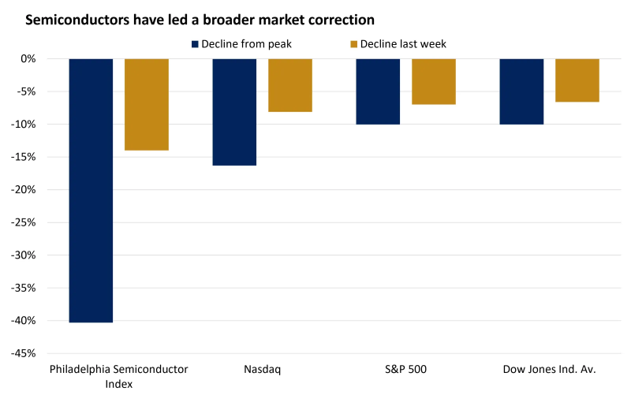
Chip stocks have borne the brunt of the AI sell-off. By Friday afternoon, the Philadelphia Semiconductor Index was about 40% below its peak, more than double the Nasdaq’s fall and roughly four times that of the Dow and the S&P 500. Source: Edward Jones, Bloomberg.
The information contained in this recording/presentation is for general information purposes only and should not be construed as, nor does it constitute financial, tax, legal, investment or any other advice. Carrick does not guarantee the suitability or potential value of any products or investments discussed herein. We make no representations or warranties of any kind, express or implied, about the completeness, accuracy, reliability, suitability or availability with respect to the information, products, services, or any other content contained in this recording for any purpose. Carrick accepts no responsibility for the suitability or accuracy of the information or for any errors or omissions that may occur. Therefore, any reliance you place on such information is strictly at your own risk. This material is provided for general information purposes only and is not personal advice to anyone to invest in any fund or product. Information taken from trade and other sources is believed to be reliable, although Carrick does not represent this as accurate or complete and it shouldn’t be relied upon as such. All material, content, and information provided by Carrick is the intellectual property of Carrick Group and its affiliates, unless otherwise stated. No part of this material may be copied, reproduced, distributed, published, or used for any commercial purpose without Carrick’s prior written consent, and is provided solely for non-commercial use. Capital is at risk. The value and income from investments can go down as well as up and are not guaranteed. An investor may get back significantly less than they invest. Past performance is not a reliable indicator of current or future performance and should not be the sole factor considered when selecting an investment.