
Week in Review: Mauritius Tightens Policy as Global Inflation and AI Risk Rise

Nov
In this Edition:
NVIDIA LEADERSHIP SHOCK TESTS AI CONFIDENCE
Jensen Huang’s departure intensified scrutiny of AI investment, financing and valuations, although US equities still ended the week firmly higher.
HOTTER US INFLATION PUSHES RATES BACK INTO FOCUS
Stronger-than-expected inflation drove Treasury yields higher and increased expectations of another Federal Reserve rate increase in December.
EUROPE AND UK GROWTH REMAIN UNEVEN
Eurozone growth slowed while the UK economy strengthened, highlighting contrasting economic momentum across the region.
ASIAN TRADE STRENGTH MEETS CURRENCY PRESSURE
Strong Chinese trade data contrasted with weak domestic demand, while a weaker yen and rising Japanese producer prices increased expectations of further BoJ tightening.
SOUTH AFRICA ADDS JOBS BUT ECONOMIC PRESSURES PERSIST
Formal employment improved, but unemployment remained elevated, manufacturing and mining stayed weak, and higher global yields weighed on local assets.
MARKET MOVES OF THE WEEK
Source: Infront (14 November 2026)
CHART OF THE WEEK
Source: Bloomberg (14 November 2026)
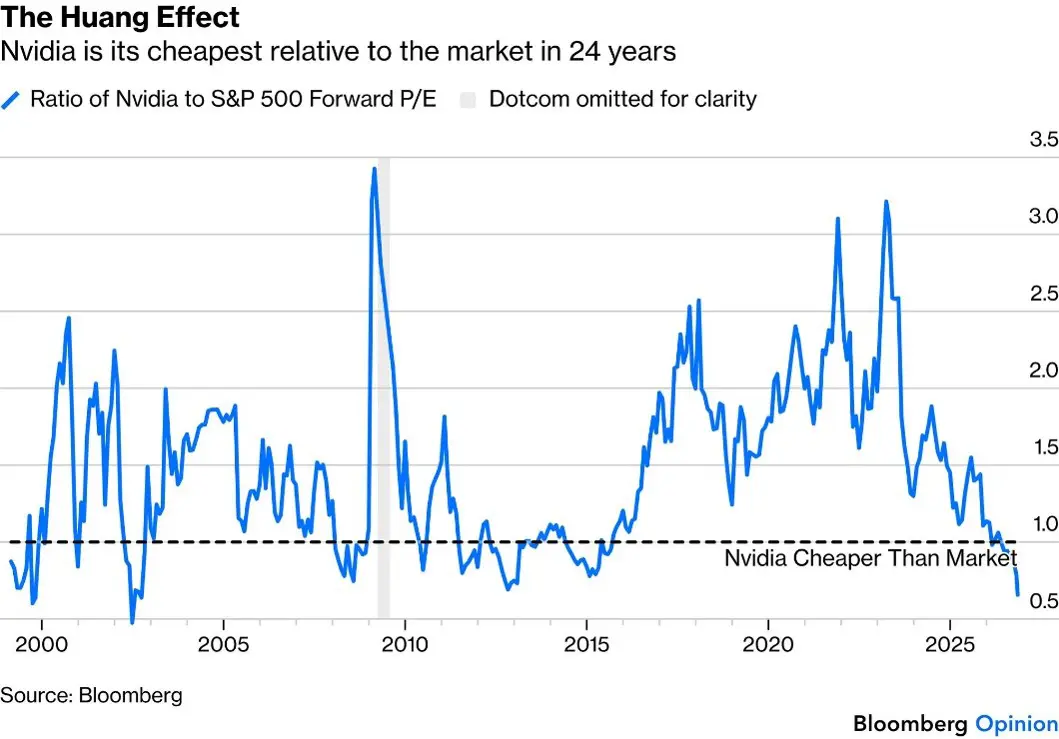
NVIDIA's valuation relative to the broader US market has fallen to its lowest level in 24 years. Its forward price-to-earnings multiple now stands at just 66% of the S&P 500's, a sharp reversal from three years ago when investors were willing to pay more than three times the market multiple.
Mauritius-based investors received a significant domestic monetary-policy signal this week. On 11 November, the Bank of Mauritius raised its Key Rate by 25 basis points to 5.00%, citing broader inflationary pressure and the risk of inflation becoming entrenched above its target range. October year-on-year inflation accelerated to 6.4%, while headline inflation on the Bank’s 12-month average measure reached 4.3%. For internationally diversified portfolios, this domestic tightening arrives alongside hotter US inflation, higher Treasury yields and renewed uncertainty around AI valuations, placing global rates, currencies and offshore asset prices firmly back at the centre of the cross-border investment outlook.
NVIDIA Leadership Shock Tests AI Confidence
NVIDIA dominated headlines last week following the departure of co-founder and Chief Executive Officer Jensen Huang. The development sent shockwaves through the technology sector, raising questions about the future leadership of the world’s most influential AI chipmaker and contributing to volatility across AI-linked stocks. The uncertainty extended beyond NVIDIA, with investors reassessing the sustainability of AI infrastructure spending and the financing arrangements underpinning the broader AI investment boom. Meanwhile, hotter-than-expected US inflation reinforced expectations of further monetary tightening, pushing bond yields higher and supporting the US dollar.
Hotter US Inflation Pushes Rates Back Into Focus
US inflation came in higher than expected in October, with consumer prices rising 0.4% month-on-month, ahead of expectations. Core inflation, which excludes food and energy, increased by a further 0.3%, marking its third consecutive monthly rise. The Bureau of Labour Statistics did not publish the usual annual CPI figure, as data collection was disrupted by the US government shutdown in October 2025. Producer prices also continued to climb, increasing by 0.3% during the month. While this was below the 0.4% expected, the annual rate accelerated from 6.3% to 6.5%, its highest level since November 2022.
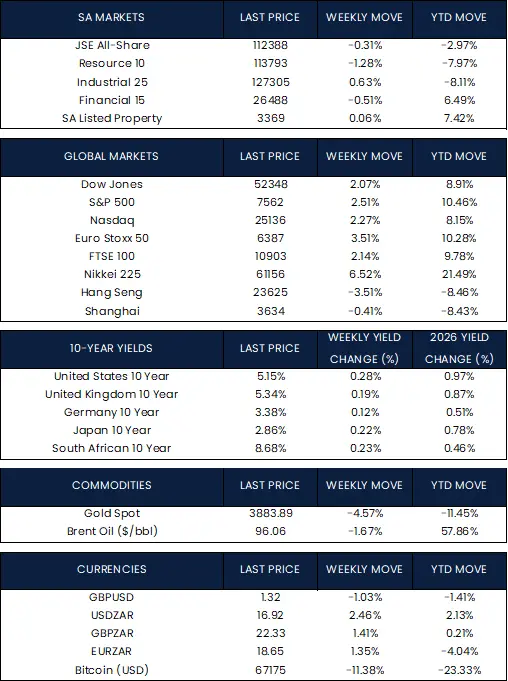
The inflation figures prompted markets to price in a further 25-basis-point rate increase in December, with the possibility of a larger 50-basis-point hike also entering the discussion. This pushed the US 10-year Treasury yield 28 basis points higher over the last week, to 5.15%.
Despite the volatility following Jensen Huang's departure from NVIDIA, US equities ended the last week firmly higher. The S&P 500 gained 2.51%, while the Nasdaq advanced 2.27% and the Dow Jones rose 2.07%.
Europe and UK Growth Remain Uneven
According to Eurostat, the eurozone economy grew by 0.4% in the third quarter, slowing from 0.6% in the previous quarter. Economic performance remained mixed across the region, with Spain continuing to show stronger growth, while Germany's economy expanded only modestly and France experienced a slight contraction. The figures highlight the uneven pace of economic recovery across Europe, with some of the region's larger economies continuing to struggle for momentum. Despite the slower growth, European equities had a positive week, with the Euro Stoxx 50 gaining 3.51%.
The UK's latest GDP figures showed that the economy grew by 0.7% in the third quarter, up from 0.5% in the previous quarter, according to the Office for National Statistics. The services sector was the main contributor to growth, supported by stronger activity in business and technology-related services. However, construction continued to weigh on overall activity, while monthly growth slowed to 0.2% in September. UK equities also ended the last week higher, with the FTSE 100 gaining 1.68%
Asian Trade Strength Meets Currency Pressure
China's exports continued to perform strongly, increasing by 35.2% year-on-year in October, although this was slightly slower than September's 36.3% growth. Imports rose by a stronger 41.6%, supported by demand for technology-related products and commodities. The extension of the US-China trade truce provided some relief from trade tensions, although weaker consumer inflation continued to highlight the challenges facing China's domestic economy.
In Japan, the weaker yen remained in focus, falling towards JPY160 against the US dollar as a stronger US dollar and expectations of further Federal Reserve rate increases weighed on the currency. Japanese producer prices also accelerated, rising 7.1% year-on-year in October, above expectations. This added to expectations that the Bank of Japan could raise interest rates in December. However, weaker household spending highlighted the pressure that higher prices continue to place on consumers.
Asian equity markets delivered a mixed performance. Japan's Nikkei 225 rose 6.52% over the last week, recovering from the previous week's losses, while the Hang Seng declined 3.51% and the Shanghai Composite fell 0.41%. Chinese technology shares came under pressure towards the end of the last week amid concerns around access to advanced US semiconductor technology.
South Africa Adds Jobs but Economic Pressures Persist
South Africa's latest labour market figures presented a mixed picture. According to Statistics South Africa, the unemployment rate edged higher to 33.7% in the third quarter, from 33.6% in the previous quarter. While 101,000 jobs were added, the number of unemployed people also increased by 97,000, highlighting the difficulty of creating enough jobs to keep pace with the growing labour force. There were some positive developments, however, with formal-sector employment increasing by 268,000, particularly in finance, manufacturing and mining.
Conditions in the mining and manufacturing sectors were less encouraging. Manufacturing production was unchanged in September compared with August, but remained 3.5% lower than a year earlier. Mining production fell by 10.7% year-on-year, although it recovered by 2.8% from the previous month.
South African markets ended the last week slightly lower, with the FTSE/JSE All Share Index declining 0.31%. Resources were the main drag on the market, falling 1.28%, while financials also lost ground, declining 0.51%. The decline was partly offset by a 0.63% gain in industrials. The rand weakened 2.46% against a stronger US dollar. Bond yields moved higher globally amid renewed inflation concerns, with the South African 10-year government bond yield rising 23 basis points to 8.68%.
The information contained in this recording/presentation is for general information purposes only and should not be construed as, nor does it constitute financial, tax, legal, investment or any other advice. Carrick does not guarantee the suitability or potential value of any products or investments discussed herein. We make no representations or warranties of any kind, express or implied, about the completeness, accuracy, reliability, suitability or availability with respect to the information, products, services, or any other content contained in this recording for any purpose. Carrick accepts no responsibility for the suitability or accuracy of the information or for any errors or omissions that may occur. Therefore, any reliance you place on such information is strictly at your own risk. This material is provided for general information purposes only and is not personal advice to anyone to invest in any fund or product. Information taken from trade and other sources is believed to be reliable, although Carrick does not represent this as accurate or complete and it shouldn’t be relied upon as such. All material, content, and information provided by Carrick is the intellectual property of Carrick Group and its affiliates, unless otherwise stated. No part of this material may be copied, reproduced, distributed, published, or used for any commercial purpose without Carrick’s prior written consent, and is provided solely for non-commercial use. Capital is at risk. The value and income from investments can go down as well as up and are not guaranteed. An investor may get back significantly less than they invest. Past performance is not a reliable indicator of current or future performance and should not be the sole factor considered when selecting an investment.