
Month in Review: AI Doubts and Rising Inflation Shape October

Nov
Market Snapshot:
Global equities fell for a second consecutive month in October, with the MSCI World down 0.8%, as doubts over the returns on heavy AI spending weighed on large technology shares. The weakness was largely confined to technology, with energy and defensive sectors such as consumer staples, healthcare and utilities posting gains.
The Nasdaq fell 5.30%, its worst month since March 2025, and the S&P 500 declined 0.93%, while the Dow Jones gained 1.70%. The sell-off hit technology-heavy Asian markets hardest, with the Nikkei falling 5.50%, the Shanghai Composite 6.33% and the Hang Seng 5.4%. European markets were mixed, with the FTSE 100 gaining 1.17% and the Euro Stoxx 50 falling 2.20%.
In commodities, Brent crude rose 13.6% as Middle East tensions escalated, adding to inflation concerns, while gold and platinum fell sharply. That correction weighed on South African equities, with resources down 9.08%, although industrials and financials gained 3.80% and 3.65% respectively, limiting the FTSE/JSE All-Share’s decline to 0.39%.
Government bonds rallied as investors looked for safer assets, and yields eased from September’s highs across major markets, with the US 10-year yield ending at 4.93% and South Africa’s at 8.73%.
Trends This Month
- Investors rewarded large technology companies with strong cloud growth but sold those whose AI spending outpaced their cash flow.
- Inflation picked up again in the US, eurozone, UK and Japan as higher energy costs fed through, keeping further rate hikes on the table.
- Emerging markets fell 8.0% in dollar terms as the chip sell-off hit Korea and Taiwan, while Brazil fell 12.0% after Lula’s unexpected re-election.
- South Africa’s fiscal outlook improved, helped by a well-received MTBPS and a GDP revision that lowered debt ratios.
Who Pays for AI? - Spending Comes Under Scrutiny
Investors focused more closely on the cost of the AI build-out and how it is being funded. The four largest US technology companies are expected to spend roughly US$750 billion on capital this year, much of it on AI data centres. Third-quarter results showed these companies maintaining or raising already substantial capital spending plans, and for several of them that spending ran ahead of the cash their businesses generated. Technology shares came under pressure, with the selling heaviest in hardware: global semiconductors fell 13.7%, while software gained 0.9%.
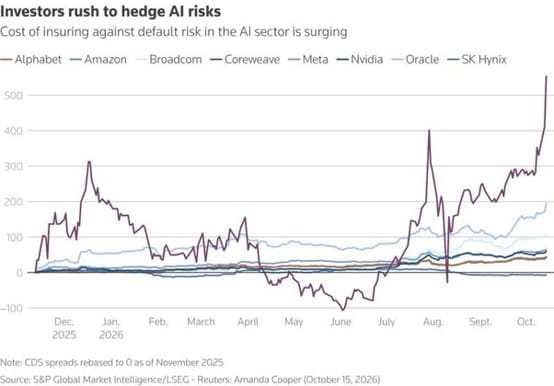
The pressure also showed up in credit markets, where borrowing costs for the more heavily indebted AI infrastructure companies rose sharply in mid-October.
Takeaway: Investors are no longer rewarding the scale of AI investment on its own.
United States – Growth Stays Strong as the Fed Holds
Equity Performance:
Dow Jones: +1.70%
S&P 500: -0.93%
Nasdaq: -5.30%
Weak results and guidance from several large technology companies weighed on the Nasdaq, while value shares held up much better than growth shares. Energy was the strongest sector, gaining 14.0% as higher oil prices supported earnings, with the major producers beating third-quarter forecasts. Bank results were mixed, with steady loan growth and consumer spending offset by weaker investment banking and trading activity.
Economic growth remained strong, with third-quarter GDP growing at an annualised 3.4%, up from 2.2% in the second quarter and ahead of expectations, supported by business investment and consumer spending. The labour market was softer, as September payrolls rose by just 29,000 and unemployment edged up to 4.2%. Households were more cautious, with consumer confidence weakening and pending home sales falling to a record low in September.
September inflation rose to 3.7% from 3.4%, with core inflation at 2.6%, and producer prices jumped 1.3% over the month as increases spread beyond energy. Against this backdrop, the Fed held its target range at 3.75%-4.00%, as expected, although two members voted for another increase. Markets still expect the policy rate to peak at around 4.6% within the next 12 months.
Outlook: Strong growth supports earnings, although rising producer prices and the possibility of a further hike could weigh on rate-sensitive parts of the market.
Europe – Inflation Rises as Growth Slows
Equity Performance:
Euro Stoxx 50: -2.20%
FTSE 100: +1.17%
European equities were mixed. Defensive sectors held up well and Germany’s DAX gained 2.5%, but European financials fell 5.4% as protests and fiscal concerns pushed French borrowing costs higher.
Eurozone inflation rose to 3.8% in September from 3.2% in August, while core inflation edged up to 2.5%. Third-quarter GDP grew 0.4% quarter on quarter, but October’s flash composite PMI fell to 51.9 from 53.1. The ECB held its deposit rate at 2.50% after discussing a hike, and Christine Lagarde announced that she will step down as ECB President on 7 February.
In the UK, September inflation rose to 3.5% from 3.1%, driven largely by higher fuel prices, and consumer confidence fell sharply. Markets increasingly expect the Bank of England to raise rates in November. The government’s first Budget raised taxes on banks while keeping its fiscal rules in place, and gilt yields edged lower as the feared sell-off didn’t materialise.
Outlook: Lower exposure to technology and stronger defensive sectors have helped European markets, but France’s fiscal position and higher energy costs remain risks to the recovery.
Japan – Equities Fall as Inflation Moves Above Target
Equity Performance:
Nikkei 225: -5.50%
Japanese equities gave back part of their strong year-to-date gains as the sell-off in AI and semiconductor shares spread through Asia.
Inflation picked up, with core consumer prices rising 2.1% year on year in September, from 1.7% in August, moving back above the BoJ’s 2% target. Wholesale price inflation eased to 6.8% from 7.6% but remained elevated. The BoJ held its policy rate at 1.25% at its 30 October meeting, although Governor Kazuo Ueda said the Bank would keep raising rates, and markets expect a further increase in December.
On the fiscal side, the government proposed household support, including a temporary cut to the consumption tax on food.
Outlook: Japan’s exposure to technology shares leaves the market sensitive to further swings in AI sentiment, while rising inflation keeps further BoJ tightening in focus.
China – Exports Surge as Domestic Demand Lags
Equity Performance:
Shanghai Composite: -6.33%
Chinese equities fell sharply, driven largely by an unwinding of speculative positions in AI and semiconductor shares, and the Hang Seng declined 5.4%. China announced its largest stimulus package since 2024, including mortgage interest subsidies for first-time homebuyers.
Data released in October showed third-quarter GDP growth accelerating to 4.5% year on year, ahead of expectations, with September exports up 36.3% in dollar terms and the monthly trade surplus at a record US$133.5 billion. More recent data was weaker, with October’s official PMIs slipping back into contraction, at 49.3 for manufacturing and 49.7 for non-manufacturing.
Domestic demand remained weak, with September retail sales growing just 1.1% and fixed-asset investment falling 7.2% over the first nine months of the year. Consumer inflation was only 0.9%, even as producer prices rose 5.0% on higher energy and commodity costs.
Outlook: Exports remain a bright spot, but weak household demand and the return to contraction in October’s PMIs suggest the recovery is losing momentum.
South Africa – Resources Slide as the Fiscal Outlook Improves
Equity Performance:
JSE All-Share: -0.39%
Resource 10: -9.08%
Industrial 25: +3.80%
Financial 15: +3.65%
SA Listed Property: +1.98%
Resources were again the weakest sector as gold fell 6.8% and platinum 16.4%, while energy and coal producers held up better on higher oil and coal prices.
The Medium-Term Budget Policy Statement was well received, with stronger tax collections allowing Treasury to borrow less despite cutting its 2026 growth forecast to 1.2% from 1.6%. Separately, Stats SA’s rebasing of GDP found the economy is 4.9% larger than previously estimated, lowering debt ratios.
Activity data remained weak, with mining output falling 12.7% year on year in August.
September headline inflation edged up to 4.5%, below expectations, although producer inflation rose to 6.2%. Temporary fuel levy cuts from November and softer-than-expected consumer inflation support expectations that the SARB will hold rates in November.
Outlook: Lower government borrowing is supportive for local bonds, but weak mining output and rising producer prices keep the growth outlook subdued.
Currencies – Rand Weakens Against Major Currencies
Key Moves:
USD/ZAR: +1.77%
GBP/ZAR: +2.80%
EUR/ZAR: +0.32%
GBP/USD: +0.97%
The rand weakened against all three major currencies, losing 1.77% against the dollar to close at R16.71. Most of the move came early in the month, as rising global bond yields and a firmer dollar weighed on emerging market currencies, and the rand softened again late in the month as gold and platinum prices fell. Sterling gained 0.97% against the dollar, leaving the pound 2.80% stronger against the rand, while the euro weakened against the dollar and gained only 0.32% against the rand.
Takeaway: Rand weakness supported rand returns on unhedged offshore holdings, particularly those in dollars and pounds.
Fixed Income – Bonds Rally Despite Higher Oil Prices
10-Year Yields (End-October | MoM change):
United States: 4.93% | -0.36%
United Kingdom: 5.29% | -0.13%
Germany: 3.32% | -0.26%
Japan: 2.77% | -0.30%
South Africa: 8.73% | -0.23%
The US led the decline in yields, with smaller moves in Japan, Germany and the UK, although Japan’s 10-year yield had briefly risen above 3%, a 30-year high, early in the month. US government bonds returned 2.4%, ahead of Japan (1.8%), Germany (1.7%) and the UK (1.6%).
Takeaway: Lower yields lifted bond returns, although higher oil prices and the risk of further rate hikes could limit how far yields fall.
Final Thoughts – Strong Growth, More Selective Investors
Economic growth held up well in October, particularly in the US, but that wasn’t enough to support every part of the market. Investors became less forgiving of heavy AI spending, especially where it is funded with debt. Inflation remains the other risk to watch, with oil above US$110 a barrel and producer prices rising in the US and South Africa. That could keep interest rates higher for longer and limit any relief on borrowing costs.
What this means for portfolios:
- Keep exposure spread across markets and sectors, as gains outside the largest technology shares offset much of their decline.
- Review concentration in AI-related holdings, particularly companies that rely on borrowing to fund their investment.
- Keep some high-quality government bonds as a diversifier, as they rallied when equities came under pressure.
- Review exposure to commodity-linked shares, which can change direction quickly.
Chart of the Month
S&P Global Market Intelligence/LSEG - Reuters: Amnada Copper (October 15,2026)
The chart shows the change in credit default swap spreads, the cost of insuring against default, for selected AI-related companies since November 2025. The sharpest rise came from a smaller, more heavily indebted AI cloud provider, whose spread rose above 1,000 basis points in October, while spreads for the large technology companies rose far less. This suggests investors are focusing on the most heavily indebted parts of the AI build-out.
The information contained in this recording/presentation is for general information purposes only and should not be construed as, nor does it constitute financial, tax, legal, investment or any other advice. Carrick does not guarantee the suitability or potential value of any products or investments discussed herein. We make no representations or warranties of any kind, express or implied, about the completeness, accuracy, reliability, suitability or availability with respect to the information, products, services, or any other content contained in this recording for any purpose. Carrick accepts no responsibility for the suitability or accuracy of the information or for any errors or omissions that may occur. Therefore, any reliance you place on such information is strictly at your own risk. This material is provided for general information purposes only and is not personal advice to anyone to invest in any fund or product. Information taken from trade and other sources is believed to be reliable, although Carrick does not represent this as accurate or complete and it shouldn’t be relied upon as such. All material, content, and information provided by Carrick is the intellectual property of Carrick Group and its affiliates, unless otherwise stated. No part of this material may be copied, reproduced, distributed, published, or used for any commercial purpose without Carrick’s prior written consent, and is provided solely for non-commercial use. Capital is at risk. The value and income from investments can go down as well as up and are not guaranteed. An investor may get back significantly less than they invest. Past performance is not a reliable indicator of current or future performance and should not be the sole factor considered when selecting an investment.