
Mauritius Faces Renewed Imported Inflation as Global Risk Rises

Oct
In this Edition:
AI INVESTMENT SCRUTINY DRIVES A DEFENSIVE ROTATION
Technology shares weakened as investors questioned the scale and sustainability of AI investment, while defensive sectors and government bonds attracted support.
FRANCE’S FISCAL RISK ADDS TO EUROPE’S CHALLENGES
Political and fiscal concerns pushed French borrowing costs sharply higher, while persistent UK inflation complicated the outlook for monetary policy.
ASIA BALANCES STRONGER GROWTH AGAINST WEAK DEMAND
Japan and Hong Kong equities weakened sharply, while stronger Chinese GDP growth masked continued softness in household spending and investment.
OIL AND GLOBAL MARKETS REPRICE RISK
Brent crude moved above $116 as Middle East tensions intensified, adding to inflation pressure and contributing to weaker global risk appetite.
SOUTH AFRICA FINDS FISCAL SUPPORT AS MARKETS RETREAT
Improved government finances and lower planned bond issuance supported local debt, but the JSE and rand weakened amid a difficult global backdrop.
MARKET MOVES OF THE WEEK
Source: Infront (24 October 2026)
CHART OF THE WEEK
Source: Bloomberg (25 October 2026)
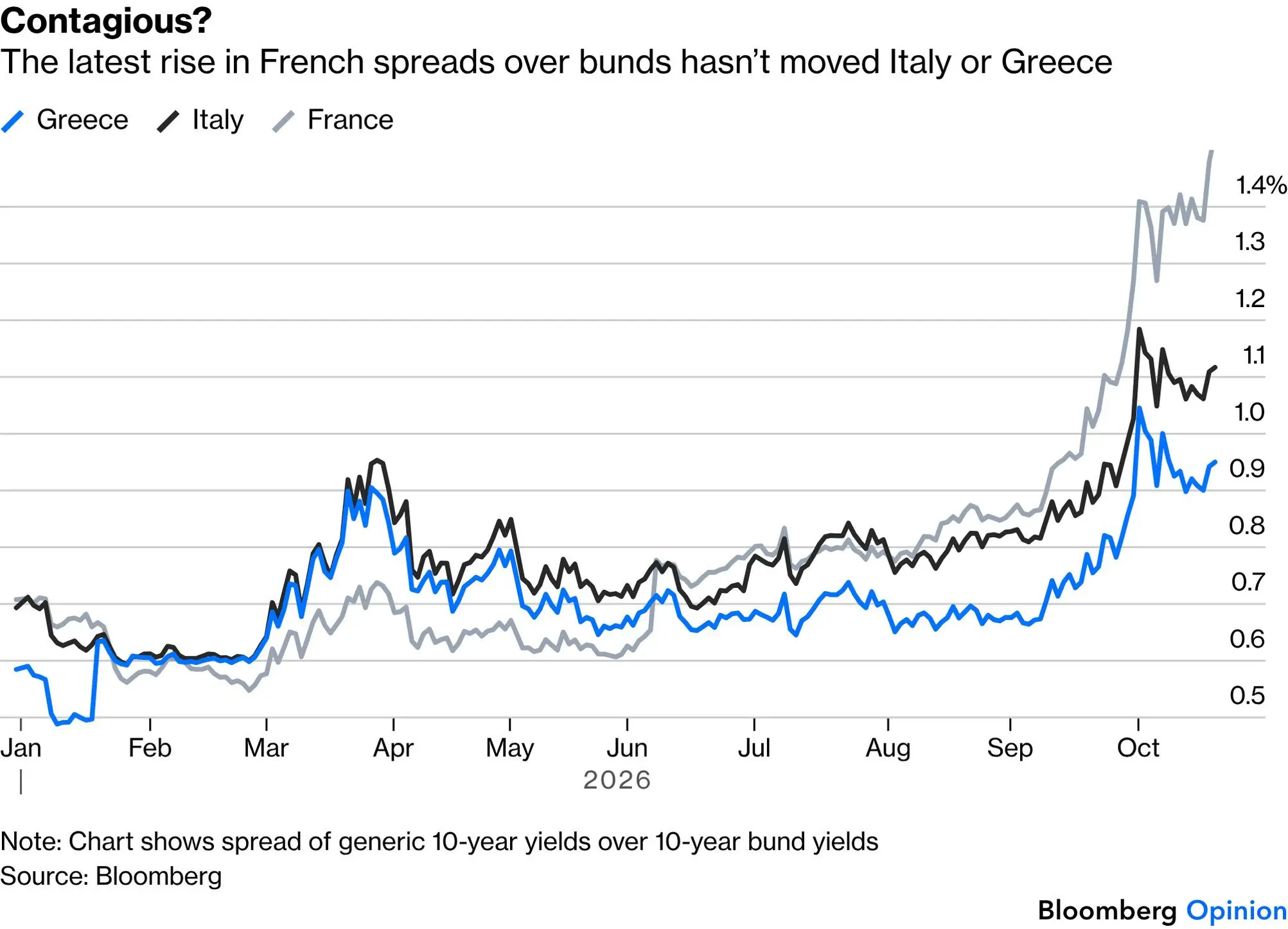
France's deepening political and fiscal crisis, exacerbated by widespread protests and unrest, has driven a sharp sell-off in government bonds. Remarkably, French 10-year yields have climbed above 5%, now exceeding those of both Italy (4.59%) and Greece (4.40%), with spreads over German bonds widening to approximately 170 basis points. However, contagion across the eurozone remains limited, suggesting investors increasingly view France's challenges as a country-specific risk rather than a broader European debt crisis. Source: Bloomberg
Global markets experienced another volatile week as investors weighed renewed concerns over artificial intelligence (AI) investment, rising energy prices and the outlook for interest rates. Technology shares came under pressure, while defensive sectors and government bonds benefited from a shift in investor sentiment. Meanwhile, escalating tensions in the Middle East pushed oil prices higher, adding to inflation concerns ahead of several important central bank meetings.
For Mauritius-based and cross-border investors, rising energy prices are again connecting the domestic inflation outlook directly with global market risk. Headline inflation for the 12 months to September reached 4.1%, with higher gasoline prices among the contributors to the quarterly rise in the consumer price index, while the Bank of Mauritius continues to hold its Key Rate at 4.75%. Against that backdrop, Brent above $116, changing US rate expectations and renewed volatility in technology and sovereign-bond markets have implications for both imported costs and internationally diversified portfolios.
AI Investment Scrutiny Drives a Defensive Rotation
In the US, technology shares led the declines as investors increasingly questioned the scale and sustainability of AI-related investment. Semiconductor stocks were particularly hard hit, with the Philadelphia Semiconductor Index falling approximately 4% over the last week. Concerns around elevated capital expenditure, rising debt levels and whether future earnings can justify current valuations weighed on sentiment. However, the weakness did not extend across the broader market, with investors rotating towards more defensive sectors, including utilities, consumer staples and healthcare.
US economic data continued to reflect a resilient economy, although signs of pressure are emerging. October's preliminary Composite PMI eased to 57.6 from 58.4, still indicating robust business activity, but businesses reported their sharpest increase in selling prices since August 2022. Meanwhile, the housing market remained under pressure, with pending home sales falling 7.3% in September to a record low. Initial jobless claims declined to 194,000, suggesting labour market conditions remain relatively stable.
Bond markets benefited from the cautious sentiment, with the US 10-year Treasury yield retreating to around 5.0% from a recent peak of 5.3%. Attention now turns to the Federal Reserve's meeting on 27–28 October, where policymakers are widely expected to leave interest rates unchanged following September's increase. However, persistent inflation pressures, particularly from energy prices, could complicate the outlook for further policy tightening.
France’s Fiscal Risk Adds to Europe’s Challenges
In Europe, France's deepening political and fiscal challenges dominated headlines. Widespread protests and civil unrest added to concerns over the country's deteriorating finances, pushing government borrowing costs sharply higher. However, Moody's unexpectedly maintained France's Aa3 credit rating on Friday, providing some relief, although its negative outlook highlights the challenges that remain. Elsewhere, eurozone business activity slowed, with the October Composite PMI declining to 51.9 from 53.1, reinforcing concerns about the strength of the region's economic recovery.
In the UK, inflation rose to 3.5% year on year in September, ahead of expectations, driven largely by higher fuel prices. While unemployment declined to 4.7%, consumer confidence deteriorated sharply, with the GfK index falling to -24 from -13. The combination of persistent inflation and weakening household sentiment presents a difficult environment for the Bank of England, with markets increasingly anticipating a further interest rate increase in November.
Asia Balances Stronger Growth Against Weak Demand
Japanese equities experienced a difficult week, reflecting the broader global sell-off in technology shares and concerns around AI-related investment. Inflation also remained in focus, with core consumer prices rising 2.1% year on year in September, up from 1.7% in August and moving back above the Bank of Japan's 2% target. While further monetary tightening remains possible, the central bank is expected to hold rates steady at its upcoming meeting.
Chinese markets also came under pressure, particularly in Hong Kong, where technology and internet-related shares led the declines. Economic data provided a more encouraging headline, with third-quarter GDP growth accelerating to 4.5% year on year from 4.3%, ahead of expectations. However, underlying activity remains uneven, with September retail sales increasing just 1.1% and fixed-asset investment declining 7.2% over the first nine months of the year. Weak domestic demand and investment continue to weigh on the broader recovery.
Oil and Global Markets Reprice Risk
Geopolitical tensions remained another important driver of market sentiment. Renewed attacks on Saudi Arabian infrastructure by Houthi forces raised concerns about potential disruptions to energy supplies, pushing Brent crude oil above $116 per barrel. Higher energy prices continue to complicate the inflation outlook, reinforcing expectations that central banks may need to maintain restrictive monetary policy for longer.
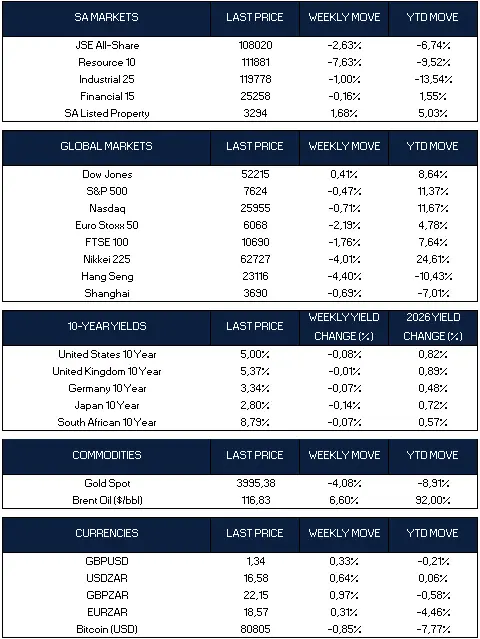
Overall, global equity markets ended last week weaker. The S&P 500 declined 0.47%, and the Nasdaq fell 0.71%, while the Dow Jones gained 0.41%. European markets also retreated, with the Euro Stoxx 50 down 2.19% and the FTSE 100 losing 1.76%. Asian markets experienced sharper declines, led by Hong Kong's Hang Seng, which fell 4.40%, and Japan's Nikkei 225, down 4.01%. Brent crude oil gained 6.60%, extending its year-to-date increase to 92.00%. In contrast, gold declined 4.08%, its sharpest weekly fall since June, briefly slipping below $4,000 an ounce. Bitcoin also weakened, declining 0.85%.
South Africa Finds Fiscal Support as Markets Retreat
Turning to South Africa, the last week was dominated by the government's Medium-Term Budget Policy Statement. National Treasury lowered its 2026 economic growth forecast to 1.2% from 1.6%, highlighting the challenges facing the domestic economy. However, stronger tax collections have helped improve the government's financial position, allowing it to reduce planned bond issuance and introduce a programme to repurchase some existing debt. These developments were welcomed by bond investors. Government also outlined additional infrastructure investment plans, although weak economic growth and elevated debt levels remain important challenges.
Inflation provided some encouraging news, despite rising slightly to 4.5% in September from 4.4% in August. The increase was smaller than expected, while underlying price pressures showed signs of easing. Importantly, government announced temporary fuel levy reductions from November to provide relief to households and businesses facing higher petrol and diesel prices. This should help cushion the impact of rising global oil prices and supports expectations that the South African Reserve Bank will leave interest rates unchanged at its November meeting.
Elsewhere, economic data continued to reflect a mixed picture. Retail sales increased 3.3% year on year in August, slightly below July's 3.4% but ahead of expectations, suggesting consumer spending remains relatively resilient. However, business confidence softened and building activity weakened, highlighting the uneven nature of the economic recovery. While consumers continue to show some resilience, stronger business investment and confidence will be important to support a more sustained improvement in economic growth.
Against this backdrop, South African financial markets experienced a difficult week. The JSE All Share Index declined 2.63%, driven by a sharp 7.63% fall in resource shares, while industrials and financials retreated 1.00% and 0.16% respectively. Listed property was a relative bright spot, gaining 1.68%. The rand weakened against the US dollar to R16.58, while the South African 10-year government bond yield declined to 8.79%, supported by a more favourable government borrowing outlook following the budget announcement.
The information contained in this recording/presentation is for general information purposes only and should not be construed as, nor does it constitute financial, tax, legal, investment or any other advice. Carrick does not guarantee the suitability or potential value of any products or investments discussed herein. We make no representations or warranties of any kind, express or implied, about the completeness, accuracy, reliability, suitability or availability with respect to the information, products, services, or any other content contained in this recording for any purpose. Carrick accepts no responsibility for the suitability or accuracy of the information or for any errors or omissions that may occur. Therefore, any reliance you place on such information is strictly at your own risk. This material is provided for general information purposes only and is not personal advice to anyone to invest in any fund or product. Information taken from trade and other sources is believed to be reliable, although Carrick does not represent this as accurate or complete and it shouldn’t be relied upon as such. All material, content, and information provided by Carrick is the intellectual property of Carrick Group and its affiliates, unless otherwise stated. No part of this material may be copied, reproduced, distributed, published, or used for any commercial purpose without Carrick’s prior written consent, and is provided solely for non-commercial use. Capital is at risk. The value and income from investments can go down as well as up and are not guaranteed. An investor may get back significantly less than they invest. Past performance is not a reliable indicator of current or future performance and should not be the sole factor considered when selecting an investment.