
Week in Review: Mauritius Investors Weigh Higher Oil Against Offshore Market Gains

Oct
In this Edition:
US MARKETS RISE AS CONSUMER CONFIDENCE WEAKENS
US equities advanced despite another volatile week for technology shares, while higher household inflation expectations and softer consumer confidence kept the Fed outlook in focus.
OIL AND BOND MARKETS KEEP INFLATION RISK ELEVATED
Brent crude moved above $104 as Middle East tensions renewed supply concerns, while strong Treasury demand provided some relief from recent multi-decade yield highs.
EUROPE WEIGHS ENERGY COSTS AGAINST WEAK GROWTH
European markets diverged as the ECB maintained a tightening bias while subdued activity and higher energy costs complicated the regional outlook.
ASIA MIXED AS CONSUMER CAUTION PERSISTS
Japan and Hong Kong advanced while mainland China weakened, with cautious household spending and shifting technology sentiment shaping regional performance.
SOUTH AFRICA FACES FUEL PRESSURE AND MANUFACTURING WEAKNESS
The JSE edged higher and the rand strengthened, but rising fuel costs and contracting manufacturing kept domestic inflation and interest-rate risks firmly in focus.
Market Moves and Chart of the Week
For Mauritius-based and cross-border investors, the latest rise in global oil prices brings imported inflation risk back into focus even as offshore equity markets provide a more constructive signal. The Bank of Mauritius continues to hold its Key Rate at 4.75%, with the island’s reliance on imported goods and energy leaving domestic prices sensitive to global fuel costs, freight and currency movements. At the same time, US equities advanced and Treasury yields eased from recent highs, highlighting the competing forces facing internationally diversified portfolios: stronger asset markets on one side and persistent inflation and interest-rate risk on the other.
US Markets Rise as Consumer Confidence Weakens
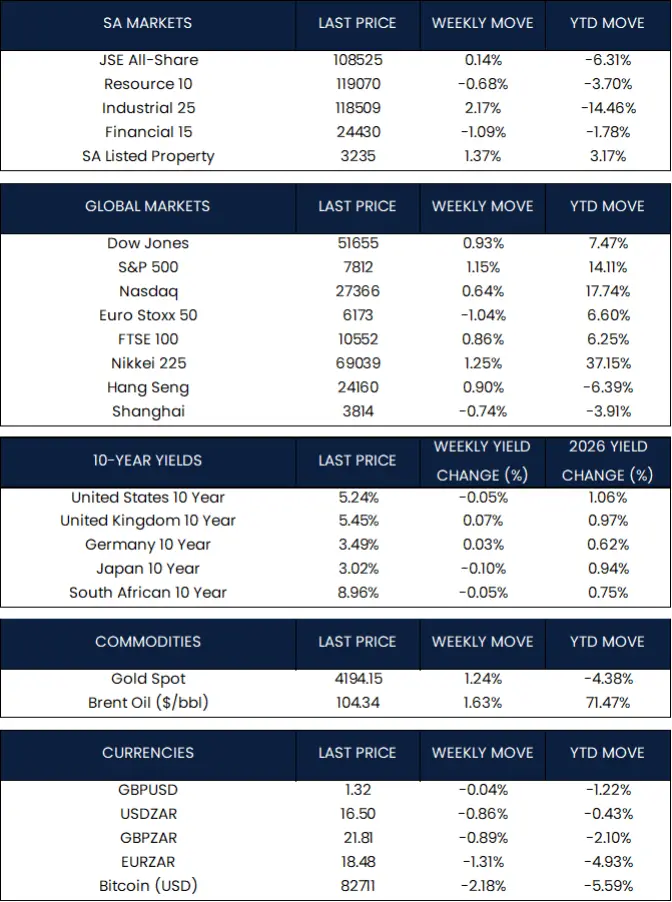
US shares advanced, with the S&P 500 gaining 1.15%, the Dow Jones rising 0.93% and the Nasdaq adding 0.64%. Consumer staples, utilities and energy stocks performed well, while technology shares experienced another volatile week as investors questioned whether expectations for AI-related companies had become too optimistic.
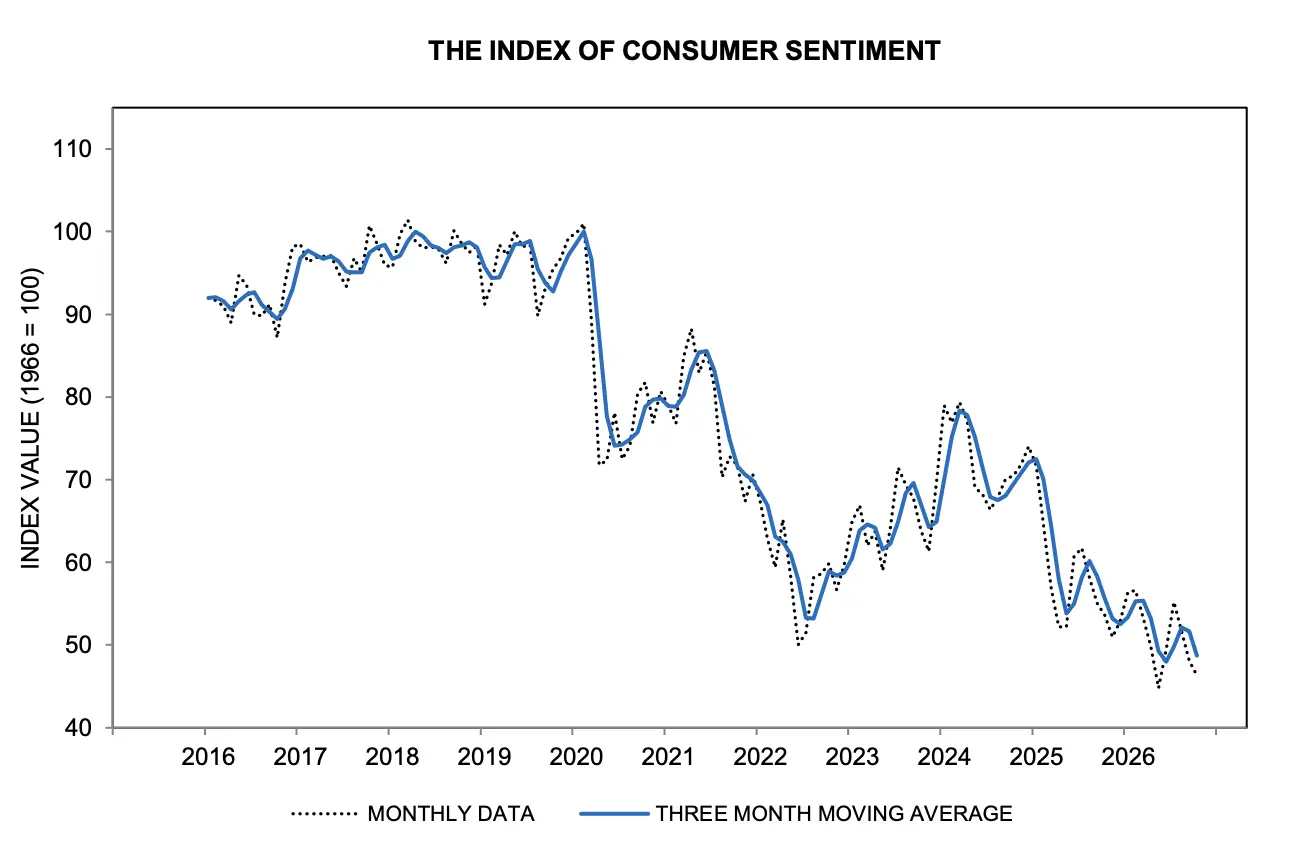
Minutes from the Federal Reserve’s September meeting suggested that another interest-rate increase remained likely before year-end, although policymakers offered little guidance on timing. Economic data showed that services businesses continued to expand, but rising costs and higher household inflation expectations remained concerns. Consumer confidence also weakened, highlighting the pressure on households.
Oil and Bond Markets Keep Inflation Risk Elevated
Oil prices remained sensitive to developments in the Middle East. News of a planned release of oil reserves initially eased supply concerns, but reports of further attacks on tankers in the Strait of Hormuz pushed prices higher again. Brent ended the last week up 1.63% at $104.34 a barrel, keeping pressure on fuel costs and the inflation outlook.
US government bond yields eased after strong demand at bond auctions, with the ten-year Treasury yield ending at 5.24%. This provided some relief after yields had reached their highest levels since 2002 earlier in the last week. Investors now look to the next inflation release for clues about whether the Fed will need to raise rates again soon.
Europe Weighs Energy Costs Against Weak Growth
European shares were mixed, with the Euro Stoxx 50 falling 1.04% while the UK’s FTSE 100 gained 0.86%. Higher energy prices and uncertainty over interest rates remained central to investor sentiment, alongside economic releases that showed uneven growth across the region.
Minutes from the European Central Bank’s September meeting showed that policymakers unanimously supported raising interest rates. Officials warned that the full effect of higher energy prices had yet to feed through to inflation, but stressed that further increases would depend on how the outlook developed. This left investors weighing the risk of more expensive borrowing against already subdued economic activity.
German exports and factory orders declined in August, although industrial production recovered from its July fall. French industrial output also weakened, partly because of lower electricity production. In the UK, business activity continued to expand at a slower pace, while house prices were unchanged, suggesting that households and businesses remained cautious.
Asia Mixed as Consumer Caution Persists
Asian markets delivered mixed results, with Japan’s Nikkei 225 gaining 1.25% and Hong Kong’s Hang Seng rising 0.90%, while the Shanghai Composite declined 0.74%. Technology shares played an important role in market movements, supporting Japanese equities early in the last week but weighing on mainland Chinese shares after exchanges reopened following the Golden Week holiday.
Chinese technology companies faced pressure from higher global borrowing costs and concerns about possible US restrictions on advanced communications products. A recovery in Hong Kong internet and technology shares helped the Hang Seng finish higher. However, concerns about the wider Chinese economy remained.
Golden Week travel figures showed that more people were taking holidays, but spending increased more slowly than visitor numbers. Together with weaker cinema ticket sales, this suggested that consumers remained careful with their money. Investors now await China’s next growth figures and policy announcements for signs of stronger support for the economy.
In Japan, the government sought to reassure investors that its plans to support households would remain consistent with responsible public finances. Proposed measures included a temporary reduction in the consumption tax on food and financial assistance for lower-income households. Wages continued to improve, but household spending remained weak, while the ten-year government bond yield eased to 3.02%.
South Africa Faces Fuel Pressure and Manufacturing Weakness
The JSE All-Share gained 0.14%, with industrials and listed property helping offset declines in resources and financial shares. Industrials advanced 2.17% and listed property gained 1.37%, while resources fell 0.68% and financials declined 1.09%. The overall market held up despite growing concerns about fuel costs, inflation and weak economic activity.
The SARB’s October Monetary Policy Review warned that higher fuel prices could spread into wages and other costs, making inflation more difficult to bring under control. Sharp increases in petrol and diesel prices added pressure to household budgets and businesses during the last week. This kept the possibility of further interest-rate increases in focus, even as the economy struggled to gain momentum.
Manufacturing output fell 4.3% compared with a year earlier, reversing July’s improvement and highlighting continued weakness in the industrial sector. Government bonds nevertheless attracted strong demand at the weekly auction, and the ten-year bond yield declined to 8.96%. The rand also strengthened, with USD/ZAR falling 0.86% to R16.50 per dollar.
Attention now turns to US inflation data on 14 October, followed by South Africa’s September inflation release and the Medium-Term Budget Policy Statement on 21 October. These will help investors assess the outlook for interest rates, household costs and government finances.
Market Moves of the Week
Source: Infront (10 October 2026)
Chart of the Week
Source: University of Michigan, Surveys of Consumers (11 October 2026)
The information contained in this recording/presentation is for general information purposes only and should not be construed as, nor does it constitute financial, tax, legal, investment or any other advice. Carrick does not guarantee the suitability or potential value of any products or investments discussed herein. We make no representations or warranties of any kind, express or implied, about the completeness, accuracy, reliability, suitability or availability with respect to the information, products, services, or any other content contained in this recording for any purpose. Carrick accepts no responsibility for the suitability or accuracy of the information or for any errors or omissions that may occur. Therefore, any reliance you place on such information is strictly at your own risk. This material is provided for general information purposes only and is not personal advice to anyone to invest in any fund or product. Information taken from trade and other sources is believed to be reliable, although Carrick does not represent this as accurate or complete and it shouldn’t be relied upon as such. All material, content, and information provided by Carrick is the intellectual property of Carrick Group and its affiliates, unless otherwise stated. No part of this material may be copied, reproduced, distributed, published, or used for any commercial purpose without Carrick’s prior written consent, and is provided solely for non-commercial use. Capital is at risk. The value and income from investments can go down as well as up and are not guaranteed. An investor may get back significantly less than they invest. Past performance is not a reliable indicator of current or future performance and should not be the sole factor considered when selecting an investment.