
Week in Review: Mauritius Investors Reassess Offshore Rates as US Hiring Slows

Oct
In this Edition:
US HIRING SLOWDOWN SHIFTS THE RATE OUTLOOK
September payrolls fell well short of expectations, easing pressure for another immediate Federal Reserve rate increase even as inflation and manufacturing costs remain elevated.
EUROZONE INFLATION KEEPS POLICY RESTRICTIVE
A sharper-than-expected rise in eurozone inflation strengthened the case for restrictive monetary policy, while UK growth remained modest and borrowing costs elevated.
ASIA DIVERGES AS JAPAN TIGHTENS AND CHINA STIMULATES
Japanese inflation reinforced expectations of further Bank of Japan tightening, while China returned to manufacturing expansion and announced additional stimulus measures.
GLOBAL BOND YIELDS RETREAT FROM MULTI-DECADE HIGHS
Sovereign yields reached new highs before softer US employment data prompted a partial bond rally, while equity performance remained mixed across major markets.
SOUTH AFRICAN MANUFACTURING IMPROVES AS LABOUR WEAKNESS PERSISTS
Manufacturing returned to expansion, but weak employment, falling local equities and rand depreciation highlighted continuing pressure on the domestic economy.
MARKET MOVES OF THE WEEK
Source: InFront (03 October 2026)
CHART OF THE WEEK
Source: Bloomberg (04 October 2026)
For Mauritius-based and cross-border investors, the softer US labour report changes the near-term discussion around global interest rates but does not remove the importance of elevated sovereign yields. The Bank of Mauritius continues to hold its Key Rate at 4.75%, maintaining a cautious stance as global energy prices, freight costs and currency movements remain potential sources of imported inflation. With Mauritius highly exposed to external price shocks and many investors internationally diversified, the interaction between US rate expectations, global bond valuations and major currencies remains especially important for both offshore portfolios and the domestic inflation environment.
US Hiring Slowdown Shifts the Rate Outlook
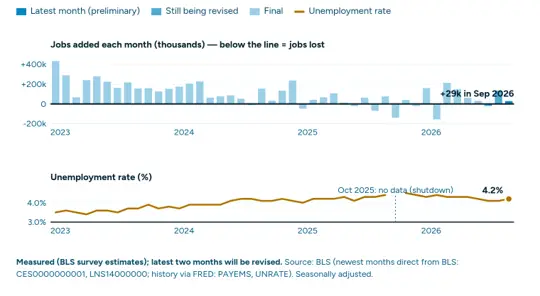
The Bureau of Labour Statistics (BLS) reported that nonfarm payrolls rose by just 29,000 in September, well below consensus expectations of around 90,000, while downward revisions cut a combined 60,000 jobs from July and August, leaving July with a net loss of 10,000.
The unemployment rate edged up to 4.2% from 4.1%, partly reflecting a rise in the labour force participation rate to 61.8%, while wage growth was sluggish. BLS data also showed job openings falling to 7.08 million in August.
Inflation data also provided some relief, with headline PCE inflation rising 0.3% in August and holding at 3.4% year on year, while core PCE inflation, which excludes food and energy prices, increased 0.2% and remained at 3.0% year on year. Both annual inflation measures were unchanged from July’s revised readings.
Second-quarter GDP growth was revised higher to an annualised 2.2%, from 1.5%, primarily reflecting stronger investment, consumer spending and government spending. Expectations for an October rate hike fell from around 70% earlier last week, following softer payrolls data and comments from Fed officials indicating that there was no urgency for a further increase following September’s hike.
Manufacturing activity remained in expansion territory in September, with the ISM Manufacturing PMI registering 54.5, marking a ninth consecutive month of expansion. New orders and employment strengthened, although the prices paid index rose sharply by 6.8 points to 77.9, its highest reading since May, pointing to renewed input cost pressures.
Eurozone Inflation Keeps Policy Restrictive
Eurozone inflation surprised to the upside in September, accelerating to 3.8% from 3.2% in August and exceeding expectations of 3.6%. The broader rise in inflation across the region reinforced expectations that the ECB may need to maintain a restrictive policy stance.
In the UK, revised data showed the economy expanded 0.5% in the second quarter, slightly above the previous estimate of 0.4%, with services remaining the principal driver of growth. Elevated gilt yields continued to create a challenging backdrop for rate-sensitive sectors, keeping attention focused on borrowing costs and the outlook for fiscal policy. Manufacturing activity also remained in expansion territory, with the S&P Global UK Manufacturing PMI rising to 51.9 in September, from 51.7 in August.
Asia Diverges as Japan Tightens and China Stimulates
In Japan, rising inflation kept expectations of further BoJ tightening in focus, with Tokyo-area core CPI accelerating to 2.7% year on year in September, from 1.8% in August. However, underlying activity remained mixed, with industrial production falling 1.7% month on month in August, while sentiment among large manufacturers improved modestly.
In China, economic activity showed signs of improvement, with the official Manufacturing PMI returning to expansion at 50.1 in September, from 49.8 in August, alongside a pickup in services activity. Authorities also announced the country’s largest stimulus package since 2024, including mortgage interest subsidies for qualified first-time homebuyers. However, the measures received a muted response from investors, with some market participants viewing the measures as insufficient to address ongoing structural challenges.
Global Bond Yields Retreat from Multi-Decade Highs
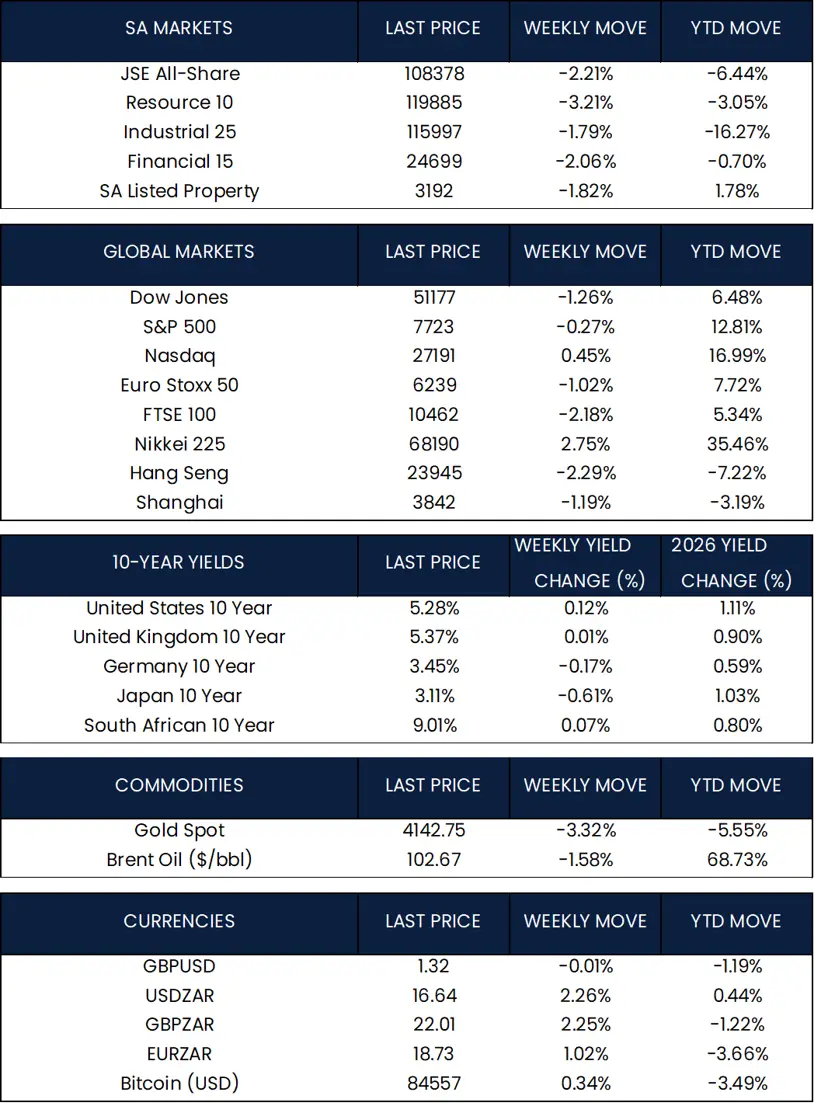
US equities finished the last week mixed as investors weighed softer US jobs data against elevated Treasury yields and volatile oil prices. The Dow Jones Industrial Average fell 1.26% and the S&P 500 declined 0.27%, while the tech-heavy Nasdaq Composite gained 0.45%.
The cautious tone extended into Europe, where higher-than-expected eurozone inflation, elevated oil prices and rising sovereign yields weighed on sentiment. The pan-European STOXX Europe 50 fell 1.02%, while the UK’s FTSE 100 declined 2.18%.
Asian markets were more mixed. In Japan, the Nikkei 225 rose 2.93%, supported by gains in AI- and semiconductor-related shares. In China, mainland markets were closed on Thursday and Friday for the Golden Week holiday. Over the three trading days through Wednesday, the Shanghai Composite fell 1.19%, while Hang Seng also fell 2.29%, with financial and technology stocks among the biggest laggards.
Against this backdrop, global sovereign bond markets remained under pressure, with the US 10-year Treasury yield reaching 5.33% and the 30-year yield 5.69% on Thursday, their highest levels since 2002. Softer US economic data subsequently prompted a partial bond rally, with the US 10-year yield ending the last week at 5.28%, up 12 bps. In Japan, the 10-year JGB yield also rose above 3%, reaching a 30-year high.
South African Manufacturing Improves as Labour Weakness Persists
Producer price inflation eased to 5.0% year on year in August, from 5.7% in July, while South Africa recorded a preliminary trade surplus of R20.5 billion in August, supported by exports of R181.8 billion against imports of R161.3 billion.
The labour market remained under pressure. Stats SA’s latest Quarterly Employment Statistics showed formal non-agricultural employment declining by 14,000 quarter-on-quarter and by 95,000 year-on-year in the second quarter. Full-time employment fell by 96,000 year-on-year, pointing to continued weakness in formal job creation. The broader Quarterly Labour Force Survey also showed the unemployment rate rising to 33.6% in the second quarter.
Local equity markets weakened over the last week, with the JSE All Share Index falling 2.21%, with all sectors declining and resources leading the losses at 3.21%. The rand depreciated 2.26% against the US dollar to R16.64/$, as a stronger greenback and rising global bond yields weighed on emerging market assets and outweighed supportive domestic data.
South African economic data remained mixed, with some improvement in manufacturing activity but continued weakness in employment. The Absa Purchasing Managers’ Index (PMI), compiled by the Bureau for Economic Research (BER), rose 4.9 points to 50.7 in September, returning to expansion territory after three consecutive months of contraction, as new sales orders rebounded sharply.
The information contained in this recording/presentation is for general information purposes only and should not be construed as, nor does it constitute financial, tax, legal, investment or any other advice. Carrick does not guarantee the suitability or potential value of any products or investments discussed herein. We make no representations or warranties of any kind, express or implied, about the completeness, accuracy, reliability, suitability or availability with respect to the information, products, services, or any other content contained in this recording for any purpose. Carrick accepts no responsibility for the suitability or accuracy of the information or for any errors or omissions that may occur. Therefore, any reliance you place on such information is strictly at your own risk. This material is provided for general information purposes only and is not personal advice to anyone to invest in any fund or product. Information taken from trade and other sources is believed to be reliable, although Carrick does not represent this as accurate or complete and it shouldn’t be relied upon as such. All material, content, and information provided by Carrick is the intellectual property of Carrick Group and its affiliates, unless otherwise stated. No part of this material may be copied, reproduced, distributed, published, or used for any commercial purpose without Carrick’s prior written consent, and is provided solely for non-commercial use. Capital is at risk. The value and income from investments can go down as well as up and are not guaranteed. An investor may get back significantly less than they invest. Past performance is not a reliable indicator of current or future performance and should not be the sole factor considered when selecting an investment.