Week in Review: Markets rise on Improved Geopolitical, Trade Outlook

Jun
In this Edition:
Markets Rally on Trade Progress Despite Mixed Economic Signals
U.S. markets hit record highs amid easing tensions and trade progress, despite mixed economic data.
Europe Balances Defense Spending with Economic Caution
NATO reinforced its defense commitments, while the ECB and BoE signaled cautious policy easing amid softening growth; European stock markets posted modest gains.
Asian Markets Climb on Reduced Trade Tensions
Japan, China, and Hong Kong markets rose strongly as easing trade concerns and a fragile Middle East ceasefire lifted investor confidence.
Fiscal Discipline Boosts Market Confidence Amid Political Strain
South Africa’s rare budget surplus was welcomed by markets despite political friction in the unity government, with the rand strengthening and local equities edging higher.
Market Moves and Chart of the Week
Markets Rally on Trade Progress and Mixed Economic Signals
U.S. stocks rallied over last week, lifted by a string of positive developments, including easing tensions in the Middle East, dovish signals from several Federal Reserve officials, news of a signed U.S.-China trade deal and indications from U.S. policymakers that further trade deals were nearing completion. The S&P 500 gained 3.4% and the Nasdaq rose 4.3% – both closing at record highs. The Dow Jones Index also managed a 3.8% w/w gain.
On the U.S. economic data front, the Fed’s preferred inflation measure ticked up slightly in May, with core PCE rising 0.2% m/m and 2.7% y/y, both just above estimates. Personal income and spending both declined, missing forecasts. Meanwhile, consumer inflation expectations for the year ahead fell sharply from 6.6% to 5%, and the University of Michigan’s consumer sentiment index jumped 16% to 60.7.
Europe Balances Security Gains with Economic Caution
NATO Secretary General Mark Rutte announced last week that all member states are on track to meet the 2% of GDP defence spending goal, with plans to raise that to 5% annually by 2035. Germany said it will increase defence spending by two-thirds by 2029. Just before the meeting in The Hague, the EU and Canada signed a new security pact, strengthening their defence ties. Following the summit, Trump reaffirmed U.S. support for NATO’s Article 5 mutual defence commitment.
European Central Bank President Christine Lagarde said that the central bank anticipates slower short-term growth but expects inflation to settle sustainably around the 2% target. Bank of England Governor Andrew Bailey told parliament that UK monetary policy focuses more on domestic rather than international factors, noting a softening labour market and rising economic slack. He said interest rates will likely decline gradually and cautiously. In market activity, the Euro Stoxx 50 rose 1.8% while the FTSE 100 eked out a 0.3% gain.
Asian Markets Climb on Reduced Trade Tensions
Japan’s stock market saw strong gains last week, with the Nikkei 225 rising 4.6%. Technology stocks performed well, boosted by reduced fears of a global trade war and early indications that the Iran-Israel ceasefire is holding, helping lift investor risk appetite.
Mainland Chinese stocks rose after the U.S. and China finalised a trade framework from last month’s Geneva talks. The Shanghai Composite rose 1.9%, and Hong Kong’s Hang Seng jumped 3.4%. The framework, announced by U.S. Commerce Secretary Howard Lutnick, eased trade tensions temporarily. Beijing confirmed parts of the deal, including commitments on rare earth exports, but details were limited and key issues like fentanyl trafficking were not addressed.
On the commodity front, oil prices fell over 18% from Monday’s highs to Tuesday’s lows before stabilizing in the mid-$60s as the near-term threat of a disruption to Middle East oil supplies receded (Brent Oil, -14% w/w). Gold dipped -2.8% w/w as risk sentiment improved globally.
Fiscal Discipline Boosts Market Confidence Amid Political Strain
South Africa recorded its first consecutive primary budget surplus in 16 years, underscoring a renewed focus on fiscal discipline. The SA Reserve Bank’s latest Quarterly Bulletin showed a surplus of R48.9 billion ($2.8 billion), or 0.7% of GDP, for the year ending March 2025. While this aligns with the National Treasury’s May forecast, it falls short of the earlier R61 billion estimate for 2024. The surplus is likely to be welcomed by investors and the unity government, which delivered its first budget after months of political wrangling over tax hikes.
President Ramaphosa’s dismissal of DA Deputy Minister of Trade, Industry and Competition Andrew Whitfield without explanation has strained the fragile government of national unity. The DA claims Whitfield was fired for traveling abroad without approval, while ANC members implicated in corruption remain in office. Despite calling the move an “assault,” the DA backed the national budget bill, saying their support was for the country, not politics.
The All-Share Index rose by 1.22% last week, held back by losses in Resources (-2.78%). The local currency strengthened against the U.S. dollar, moving to R17.80/$ from the previous week’s R18.01/$ level. SA government bond yields moved lower on the week, dipping 0.08%.
Market Moves of the Week
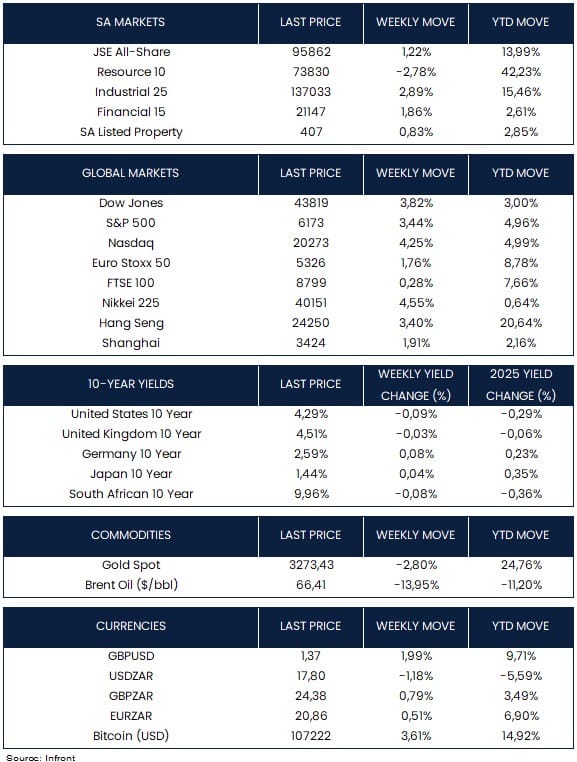
Chart of the Week
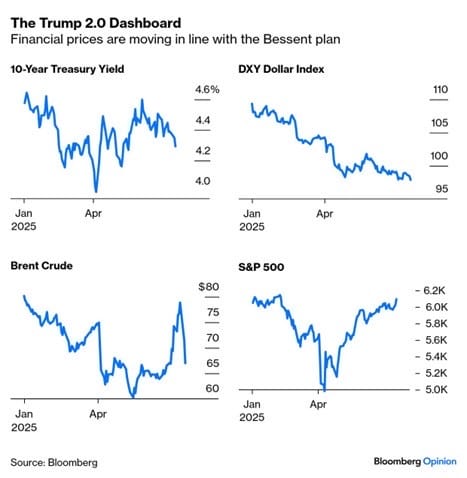
International markets are handing Trump 2.0 another victory. The S&P 500 is back to its record. Treasury Secretary Scott Bessent has targeted lower bond yields, cheaper oil, and a weaker dollar. The market is delivering all of them. Source: Bloomberg